

CF1905E.One-X
提高+/省选-
通过率:0%
时间限制:3.00s
内存限制:512MB


AC君温馨提醒
该题目为【codeforces】题库的题目,您提交的代码将被提交至codeforces进行远程评测,并由ACGO抓取测评结果后进行展示。由于远程测评的测评机由其他平台提供,我们无法保证该服务的稳定性,若提交后无反应,请等待一段时间后再进行重试。
题目描述
In this sad world full of imperfections, ugly segment trees exist.
A segment tree is a tree where each node represents a segment and has its number. A segment tree for an array of n elements can be built in a recursive manner. Let's say function build(v,l,r) builds the segment tree rooted in the node with number v and it corresponds to the segment [l,r].
Now let's define build(v,l,r):
- If l=r, this node v is a leaf so we stop adding more edges
- Else, we add the edges (v,2v) and (v,2v+1). Let m=⌊2l+r⌋. Then we call build(2v,l,m) and build(2v+1,m+1,r).
So, the whole tree is built by calling build(1,1,n).
Now Ibti will construct a segment tree for an array with n elements. He wants to find the sum of lca†(S), where S is a non-empty subset of leaves. Notice that there are exactly 2n−1 possible subsets. Since this sum can be very large, output it modulo 998244353.
†lca(S) is the number of the least common ancestor for the nodes that are in S.
在这个充满缺憾的悲伤世界中,丑陋的线段树确实存在。
线段树是一种树形结构,其中每个节点代表一个区间并拥有一个编号。对于一个包含 n 个元素的数组,其线段树可通过递归方式构建。我们定义函数 build(v,l,r) 表示以编号为 v 的节点为根、对应区间为 [l,r] 的线段树的构建过程。
下面给出 build(v,l,r) 的定义:
- 若 l=r,则该节点 v 是叶子节点,不再添加新的边;
- 否则,添加两条边 (v,2v) 和 (v,2v+1);令 m=⌊2l+r⌋,然后递归调用 build(2v,l,m) 和 build(2v+1,m+1,r)。
因此,整棵线段树通过调用 build(1,1,n) 构建而成。
现在 Ibti 将为一个含 n 个元素的数组构造一棵线段树。他希望求出所有非空叶子节点子集 S 对应的 lca†(S) 的总和。注意这样的子集共有 2n−1 个。由于该总和可能非常大,请将结果对 998244353 取模后输出。
†lca(S) 表示集合 S 中所有节点的最近公共祖先(LCA)的编号。
输入格式
Each test consists of multiple test cases. The first line contains a single integer t (1≤t≤103) — the number of test cases. The description of the test cases follows.
The first line of each test case contains a single integer n (2≤n≤1018) — the length of the array for which the segment tree is built.
每个测试包含多个测试用例。第一行包含一个整数 t(1≤t≤103),表示测试用例的数量。随后是各测试用例的描述。
每个测试用例的第一行包含一个整数 n(2≤n≤1018),表示为其构建线段树的数组长度。
输出格式
For each test case, output a single integer — the required sum modulo 998244353.
对于每个测试用例,输出一个整数——所求的和对 998244353 取模的结果。
输入输出样例
输入#1
5
2
3
4
5
53278
输出#1
6
17
36
69
593324855
说明/提示
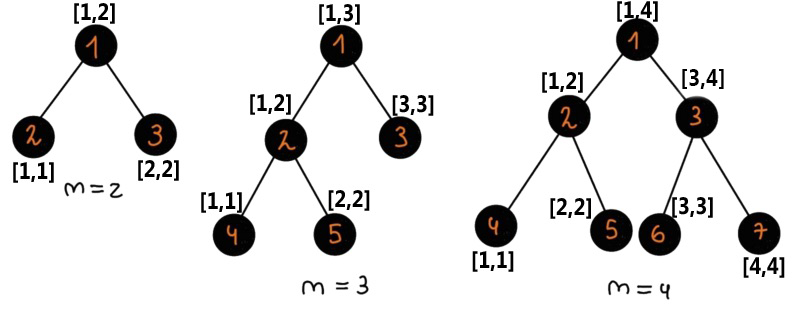
In the first test case:
Let's look at all subsets of leaves.
- lca(2)=2;
- lca(3)=3;
- lca(2,3)=1.
Thus, the answer is 2+3+1=6.
In the second test case:
Let's look at all subsets of leaves.
- lca(4)=4;
- lca(5)=5;
- lca(3)=3;
- lca(4,5)=2;
- lca(4,3)=1;
- lca(5,3)=1;
- lca(4,5,3)=1;
Thus, the answer is 4+5+3+2+1+1+1=17.
在第一个测试用例中:
我们考察所有叶子节点的子集。
- lca(2)=2;
- lca(3)=3;
- lca(2,3)=1。
因此,答案为 2+3+1=6。
在第二个测试用例中:
我们考察所有叶子节点的子集。
- lca(4)=4;
- lca(5)=5;
- lca(3)=3;
- lca(4,5)=2;
- lca(4,3)=1;
- lca(5,3)=1;
- lca(4,5,3)=1;
因此,答案为 4+5+3+2+1+1+1=17。
输入解题思路,AI测评打分。不知道怎么写?