

CF1797F.Li Hua and Path
NOI/NOI+/CTSC
通过率:0%
时间限制:2.00s
内存限制:256MB


AC君温馨提醒
该题目为【codeforces】题库的题目,您提交的代码将被提交至codeforces进行远程评测,并由ACGO抓取测评结果后进行展示。由于远程测评的测评机由其他平台提供,我们无法保证该服务的稳定性,若提交后无反应,请等待一段时间后再进行重试。
题目描述
Li Hua has a tree of n vertices and n−1 edges. The vertices are numbered from 1 to n.
A pair of vertices (u,v) (u<v) is considered cute if exactly one of the following two statements is true:
- u is the vertex with the minimum index among all vertices on the path (u,v).
- v is the vertex with the maximum index among all vertices on the path (u,v).
There will be m operations. In each operation, he decides an integer kj, then inserts a vertex numbered n+j to the tree, connecting with the vertex numbered kj.
He wants to calculate the number of cute pairs before operations and after each operation.
Suppose you were Li Hua, please solve this problem.
李华有一棵包含 n 个顶点和 n−1 条边的树。顶点编号为 1 到 n。
若一对顶点 (u,v)(满足 u<v)恰好满足以下两个命题中的一个为真,则称其为“可爱对”:
- u 是路径 (u,v) 上所有顶点中编号最小的顶点;
- v 是路径 (u,v) 上所有顶点中编号最大的顶点。
接下来将进行 m 次操作。每次操作中,他选定一个整数 kj,并向树中插入一个编号为 n+j 的新顶点,并将其与编号为 kj 的顶点相连。
他希望计算初始时(所有操作前)以及每次操作后的“可爱对”的数量。
假设你是李华,请解决该问题。
输入格式
The first line contains the single integer n (2≤n≤2⋅105) — the number of vertices in the tree.
Next n−1 lines contain the edges of the tree. The i-th line contains two integers ui and vi (1≤ui,vi≤n; ui=vi) — the corresponding edge. The given edges form a tree.
The next line contains the single integer m (1≤m≤2⋅105) — the number of operations.
Next m lines contain operations — one operation per line. The j-th operation contains one integer kj (1≤kj<n+j) — a vertex.
第一行包含一个整数 n(2≤n≤2⋅105)——树中顶点的数量。
接下来的 n−1 行描述树的边。第 i 行包含两个整数 ui 和 vi(1≤ui,vi≤n;ui=vi)——对应的一条边。所给的边构成一棵树。
接下来一行包含一个整数 m(1≤m≤2⋅105)——操作的数量。
接下来的 m 行每行描述一个操作。第 j 个操作包含一个整数 kj(1≤kj<n+j)——一个顶点。
输出格式
Print m+1 integers — the number of cute pairs before operations and after each operation.
输出 m+1 个整数——分别为操作前以及每次操作后的“可爱对”数量。
输入输出样例
输入#1
7
2 1
1 3
1 4
4 6
4 7
6 5
2
5
6
输出#1
11
15
19
说明/提示
The initial tree is shown in the following picture:
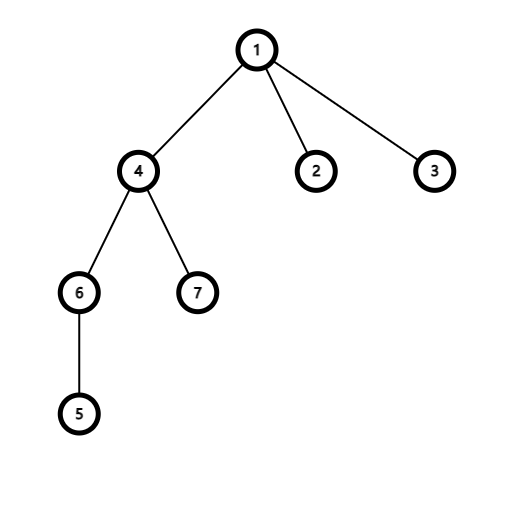
There are 11 cute pairs — (1,5),(2,3),(2,4),(2,6),(2,7),(3,4),(3,6),(3,7),(4,5),(5,7),(6,7).
Similarly, we can count the cute pairs after each operation and the result is 15 and 19.
初始树如下图所示:
共有 11 个“可爱对”——(1,5),(2,3),(2,4),(2,6),(2,7),(3,4),(3,6),(3,7),(4,5),(5,7),(6,7)。
类似地,我们可以统计每次操作后的“可爱对”数量,结果分别为 15 和 19。
输入解题思路,AI测评打分。不知道怎么写?