

CF1797A.Li Hua and Maze
入门
通过率:0%
时间限制:1.00s
内存限制:256MB


AC君温馨提醒
该题目为【codeforces】题库的题目,您提交的代码将被提交至codeforces进行远程评测,并由ACGO抓取测评结果后进行展示。由于远程测评的测评机由其他平台提供,我们无法保证该服务的稳定性,若提交后无反应,请等待一段时间后再进行重试。
题目描述
There is a rectangular maze of size n×m. Denote (r,c) as the cell on the r-th row from the top and the c-th column from the left. Two cells are adjacent if they share an edge. A path is a sequence of adjacent empty cells.
Each cell is initially empty. Li Hua can choose some cells (except (x1,y1) and (x2,y2)) and place an obstacle in each of them. He wants to know the minimum number of obstacles needed to be placed so that there isn't a path from (x1,y1) to (x2,y2).
Suppose you were Li Hua, please solve this problem.
有一个大小为 n×m 的矩形迷宫。记 (r,c) 表示从上往下数第 r 行、从左往右数第 c 列的格子。若两个格子共享一条边,则称它们相邻。一条路径是指一系列相邻的空格子组成的序列。
每个格子初始均为空。李华可以选择若干个格子(但不能选 (x1,y1) 和 (x2,y2))并在其中各放置一个障碍物。他想知道:为使得从 (x1,y1) 到 (x2,y2) 不存在任何路径,所需放置的障碍物的最少数量是多少?
假设你是李华,请解决此问题。
输入格式
The first line contains the single integer t (1≤t≤500) — the number of test cases.
The first line of each test case contains two integers n,m (4≤n,m≤109) — the size of the maze.
The second line of each test case contains four integers x1,y1,x2,y2 (1≤x1,x2≤n,1≤y1,y2≤m) — the coordinates of the start and the end.
It is guaranteed that ∣x1−x2∣+∣y1−y2∣≥2.
第一行包含一个整数 t(1≤t≤500)——测试用例的数量。
每个测试用例的第一行包含两个整数 n,m(4≤n,m≤109)——迷宫的尺寸。
每个测试用例的第二行包含四个整数 x1,y1,x2,y2(1≤x1,x2≤n, 1≤y1,y2≤m)——起点和终点的坐标。
保证 ∣x1−x2∣+∣y1−y2∣≥2。
输出格式
For each test case print the minimum number of obstacles you need to put on the field so that there is no path from (x1,y1) to (x2,y2).
对于每个测试用例,输出需要在场地上放置的障碍物的最少数量,使得从 (x1,y1) 到 (x2,y2) 不存在路径。
输入输出样例
输入#1
3
4 4
2 2 3 3
6 7
1 1 2 3
9 9
5 1 3 6
输出#1
4
2
3
说明/提示
In test case 1, you can put obstacles on (1,3),(2,3),(3,2),(4,2). Then the path from (2,2) to (3,3) will not exist.
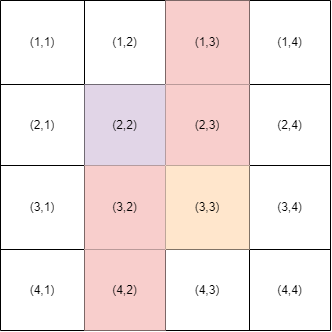
在测试用例 1 中,你可以在格子 (1,3)、(2,3)、(3,2) 和 (4,2) 上放置障碍物。此时,从 (2,2) 到 (3,3) 的路径将不存在。
输入解题思路,AI测评打分。不知道怎么写?