

CF1700A.Optimal Path
入门
通过率:0%
时间限制:2.00s
内存限制:256MB


AC君温馨提醒
该题目为【codeforces】题库的题目,您提交的代码将被提交至codeforces进行远程评测,并由ACGO抓取测评结果后进行展示。由于远程测评的测评机由其他平台提供,我们无法保证该服务的稳定性,若提交后无反应,请等待一段时间后再进行重试。
题目描述
You are given a table a of size n×m. We will consider the table rows numbered from top to bottom from 1 to n, and the columns numbered from left to right from 1 to m. We will denote a cell that is in the i-th row and in the j-th column as (i,j). In the cell (i,j) there is written a number (i−1)⋅m+j, that is aij=(i−1)⋅m+j.
A turtle initially stands in the cell (1,1) and it wants to come to the cell (n,m). From the cell (i,j) it can in one step go to one of the cells (i+1,j) or (i,j+1), if it exists. A path is a sequence of cells in which for every two adjacent in the sequence cells the following satisfies: the turtle can reach from the first cell to the second cell in one step. A cost of a path is the sum of numbers that are written in the cells of the path.
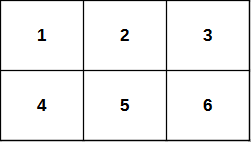
For example, with n=2 and m=3 the table will look as shown above. The turtle can take the following path: (1,1)→(1,2)→(1,3)→(2,3). The cost of such way is equal to a11+a12+a13+a23=12. On the other hand, the paths (1,1)→(1,2)→(2,2)→(2,1) and (1,1)→(1,3) are incorrect, because in the first path the turtle can't make a step (2,2)→(2,1), and in the second path it can't make a step (1,1)→(1,3).
You are asked to tell the turtle a minimal possible cost of a path from the cell (1,1) to the cell (n,m). Please note that the cells (1,1) and (n,m) are a part of the way.
给你一个大小为 n×m 的表格 a。我们将表格的行从上到下编号为 1 到 n,列从左到右编号为 1 到 m。我们将位于第 i 行、第 j 列的单元格记作 (i,j)。在单元格 (i,j) 中写有一个数 (i−1)⋅m+j,即 aij=(i−1)⋅m+j。
一只乌龟初始位于单元格 (1,1),它希望到达单元格 (n,m)。从单元格 (i,j) 出发,乌龟每一步可以移动到 (i+1,j) 或 (i,j+1)(若该单元格存在)。一条路径是指一个单元格序列,其中任意两个相邻单元格均满足:乌龟能从第一个单元格一步到达第二个单元格。一条路径的代价定义为该路径中所有单元格内所写数字之和。
例如,当 n=2 且 m=3 时,表格如上图所示。乌龟可选择如下路径:(1,1)→(1,2)→(1,3)→(2,3)。该路径的代价为 a11+a12+a13+a23=12。另一方面,路径 (1,1)→(1,2)→(2,2)→(2,1) 和 (1,1)→(1,3) 均不合法:因为在第一条路径中,乌龟无法从 (2,2) 一步移动到 (2,1);而在第二条路径中,乌龟也无法从 (1,1) 一步移动到 (1,3)。
你需要告诉乌龟:从单元格 (1,1) 到单元格 (n,m) 的所有可能路径中,最小可能的代价是多少?请注意,起点 (1,1) 和终点 (n,m) 均属于路径的一部分。
输入格式
The first line contains a single integer t (1≤t≤1000) — the number of test cases. The description of test cases follows.
A single line of each test case contains two integers n and m (1≤n,m≤104) — the number of rows and columns of the table a respectively.
第一行包含一个整数 t(1≤t≤1000),表示测试用例的数量。接下来是各测试用例的描述。
每个测试用例占一行,包含两个整数 n 和 m(1≤n,m≤104),分别表示表格 a 的行数和列数。
输出格式
For each test case output a single integer — a minimal possible cost of a path from the cell (1,1) to the cell (n,m).
对于每个测试用例,输出一个整数——从单元格 (1,1) 到单元格 (n,m) 的路径的最小可能代价。
输入输出样例
输入#1
7
1 1
2 3
3 2
7 1
1 10
5 5
10000 10000
输出#1
1
12
13
28
55
85
500099995000
说明/提示
In the first test case the only possible path consists of a single cell (1,1).
The path with the minimal cost in the second test case is shown in the statement.
In the fourth and the fifth test cases there is only one path from (1,1) to (n,m). Both paths visit every cell in the table.
在第一个测试用例中,唯一可能的路径仅包含单个单元格 (1,1)。
第二个测试用例中代价最小的路径已在题目陈述中给出。
在第四个和第五个测试用例中,从 (1,1) 到 (n,m) 只存在一条路径。这两条路径均遍历表格中的每个单元格。
输入解题思路,AI测评打分。不知道怎么写?