

CF1707C.DFS Trees
提高+/省选-
通过率:0%
时间限制:1.00s
内存限制:256MB


AC君温馨提醒
该题目为【codeforces】题库的题目,您提交的代码将被提交至codeforces进行远程评测,并由ACGO抓取测评结果后进行展示。由于远程测评的测评机由其他平台提供,我们无法保证该服务的稳定性,若提交后无反应,请等待一段时间后再进行重试。
题目描述
You are given a connected undirected graph consisting of n vertices and m edges. The weight of the i-th edge is i.
Here is a wrong algorithm of finding a minimum spanning tree (MST) of a graph:
vis := an array of length n
s := a set of edges
function dfs(u):
vis[u] := true
iterate through each edge (u, v) in the order from smallest to largest edge weight
if vis[v] = false
add edge (u, v) into the set (s)
dfs(v)
function findMST(u):
reset all elements of (vis) to false
reset the edge set (s) to empty
dfs(u)
return the edge set (s)
Each of the calls findMST(1), findMST(2), ..., findMST(n) gives you a spanning tree of the graph. Determine which of these trees are minimum spanning trees.
给你一个由 n 个顶点和 m 条边组成的连通无向图。第 i 条边的权重为 i。
以下是求图的最小生成树(MST)的一个错误算法:
vis := 长度为 n 的数组
s := 边的集合
function dfs(u):
vis[u] := true
按照边权从小到大的顺序,遍历与 u 相连的每条边 (u,v)
if vis[v] = false
将边 (u,v) 加入集合 s
dfs(v)
function findMST(u):
将数组 vis 的所有元素重置为 false
将边集 s 重置为空集
dfs(u)
return 边集 s
对每个 u=1,2,…,n,调用 findMST(u) 均会得到该图的一棵生成树。请判断这些生成树中哪些是最小生成树。
输入格式
The first line of the input contains two integers n, m (2≤n≤105, n−1≤m≤2⋅105) — the number of vertices and the number of edges in the graph.
Each of the following m lines contains two integers ui and vi (1≤ui,vi≤n, ui=vi), describing an undirected edge (ui,vi) in the graph. The i-th edge in the input has weight i.
It is guaranteed that the graph is connected and there is at most one edge between any pair of vertices.
输入的第一行包含两个整数 n 和 m(2≤n≤105,n−1≤m≤2⋅105),分别表示图中顶点的数量和边的数量。
接下来的 m 行,每行包含两个整数 ui 和 vi(1≤ui,vi≤n,ui=vi),描述图中的一条无向边 (ui,vi)。输入中第 i 条边的权重为 i。
保证该图是连通的,且任意两个顶点之间至多存在一条边。
输出格式
You need to output a binary string s, where si=1 if findMST(i) creates an MST, and si=0 otherwise.
你需要输出一个二进制字符串 s,其中若 findMST(i) 生成一棵最小生成树(MST),则 si=1;否则 si=0。
输入输出样例
输入#1
5 5
1 2
3 5
1 3
3 2
4 2
输出#1
01111
输入#2
10 11
1 2
2 5
3 4
4 2
8 1
4 5
10 5
9 5
8 2
5 7
4 6
输出#2
0011111011
说明/提示
Here is the graph given in the first example.
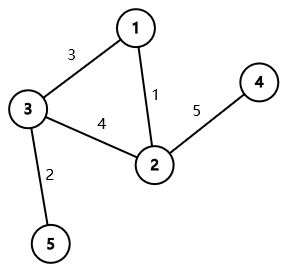
There is only one minimum spanning tree in this graph. A minimum spanning tree is (1,2),(3,5),(1,3),(2,4) which has weight 1+2+3+5=11.
Here is a part of the process of calling findMST(1):
- reset the array vis and the edge set s;
- calling dfs(1);
- vis[1] := true;
- iterate through each edge (1,2),(1,3);
- add edge (1,2) into the edge set s, calling dfs(2):
- vis[2] := true
- iterate through each edge (2,1),(2,3),(2,4);
- because vis[1] = true, ignore the edge (2,1);
- add edge (2,3) into the edge set s, calling dfs(3):
- ...
In the end, it will select edges (1,2),(2,3),(3,5),(2,4) with total weight 1+4+2+5=12>11, so findMST(1) does not find a minimum spanning tree.
It can be shown that the other trees are all MSTs, so the answer is 01111.
以下是第一个示例中给出的图。
该图中仅存在一棵最小生成树(MST)。这棵最小生成树包含边 (1,2),(3,5),(1,3),(2,4),其总权重为 1+2+3+5=11。
以下是调用 findMST(1) 过程的部分步骤:
- 重置数组
vis和边集s; - 调用
dfs(1); vis[1] := true;- 遍历与顶点 1 相连的每条边:(1,2),(1,3);
- 将边 (1,2) 加入边集
s,并调用dfs(2):vis[2] := true;- 遍历与顶点 2 相连的每条边:(2,1),(2,3),(2,4);
- 因为
vis[1] = true,故忽略边 (2,1); - 将边 (2,3) 加入边集
s,并调用dfs(3):- ...
最终,算法选出的边为 (1,2),(2,3),(3,5),(2,4),总权重为 1+4+2+5=12>11,因此 findMST(1) 并未找到最小生成树。
可以证明其余以顶点 2、3、4、5 为起点的 findMST(i) 均能正确找到最小生成树,故答案为 01111。
输入解题思路,AI测评打分。不知道怎么写?