

CF1710A.Color the Picture
普及/提高-
通过率:0%
时间限制:1.00s
内存限制:256MB


AC君温馨提醒
该题目为【codeforces】题库的题目,您提交的代码将被提交至codeforces进行远程评测,并由ACGO抓取测评结果后进行展示。由于远程测评的测评机由其他平台提供,我们无法保证该服务的稳定性,若提交后无反应,请等待一段时间后再进行重试。
题目描述
A picture can be represented as an n×m grid (n rows and m columns) so that each of the n⋅m cells is colored with one color. You have k pigments of different colors. You have a limited amount of each pigment, more precisely you can color at most ai cells with the i-th pigment.
A picture is considered beautiful if each cell has at least 3 toroidal neighbors with the same color as itself.
Two cells are considered toroidal neighbors if they toroidally share an edge. In other words, for some integers 1≤x1,x2≤n and 1≤y1,y2≤m, the cell in the x1-th row and y1-th column is a toroidal neighbor of the cell in the x2-th row and y2-th column if one of following two conditions holds:
- x1−x2≡±1(modn) and y1=y2, or
- y1−y2≡±1(modm) and x1=x2.
Notice that each cell has exactly 4 toroidal neighbors. For example, if n=3 and m=4, the toroidal neighbors of the cell (1,2) (the cell on the first row and second column) are: (3,2), (2,2), (1,3), (1,1). They are shown in gray on the image below:
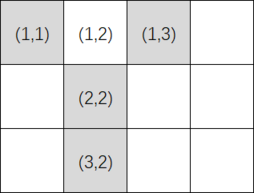 The gray cells show toroidal neighbors of (1,2).
Is it possible to color all cells with the pigments provided and create a beautiful picture?
一幅图像可以表示为一个 n×m 的网格(n 行、m 列),其中 n⋅m 个单元格中的每一个均被染成一种颜色。你有 k 种不同颜色的颜料,且每种颜料的数量有限:具体而言,第 i 种颜料最多可给 ai 个单元格上色。
若图像中每个单元格都至少有 3 个环面邻接单元格(toroidal neighbor)与其颜色相同,则该图像被称为“优美的”。
两个单元格被称为环面邻接单元格,当且仅当它们在环面上共享一条边。换言之,对任意整数 1≤x1,x2≤n 和 1≤y1,y2≤m,位于第 x1 行、第 y1 列的单元格与位于第 x2 行、第 y2 列的单元格互为环面邻接单元格,当且仅当满足以下两个条件之一:
- x1−x2≡±1(modn) 且 y1=y2,或
- y1−y2≡±1(modm) 且 x1=x2。
注意:每个单元格恰好有 4 个环面邻接单元格。例如,当 n=3 且 m=4 时,单元格 (1,2)(即第 1 行、第 2 列的单元格)的环面邻接单元格为:(3,2)、(2,2)、(1,3)、(1,1)。如下图中灰色单元格所示:
灰色单元格表示 (1,2) 的环面邻接单元格。
能否使用所给颜料为所有单元格上色,从而构造出一幅优美的图像?
输入格式
Each test contains multiple test cases. The first line contains the number of test cases t (1≤t≤104). The description of the test cases follows.
The first line of each test case contains three integers n, m, and k (3≤n,m≤109, 1≤k≤105) — the number of rows and columns of the picture and the number of pigments.
The next line contains k integers a1,a2,…,ak (1≤ai≤109) — ai is the maximum number of cells that can be colored with the i-th pigment.
It is guaranteed that the sum of k over all test cases does not exceed 105.
每个测试包含多个测试用例。第一行包含测试用例的数量 t(1≤t≤104)。随后是各测试用例的描述。
每个测试用例的第一行包含三个整数 n、m 和 k(3≤n,m≤109,1≤k≤105)——分别表示图片的行数、列数以及颜料种类数。
下一行包含 k 个整数 a1,a2,…,ak(1≤ai≤109)——其中 ai 表示第 i 种颜料最多可涂色的格子数。
保证所有测试用例中 k 的总和不超过 105。
输出格式
For each test case, print "Yes" (without quotes) if it is possible to color a beautiful picture. Otherwise, print "No" (without quotes).
对于每个测试用例,如果能够绘制出一幅美丽的图画,则输出“Yes”(不带引号);否则,输出“No”(不带引号)。
输入输出样例
输入#1
6
4 6 3
12 9 8
3 3 2
8 8
3 3 2
9 5
4 5 2
10 11
5 4 2
9 11
10 10 3
11 45 14
输出#1
Yes
No
Yes
Yes
No
No
说明/提示
In the first test case, one possible solution is as follows:
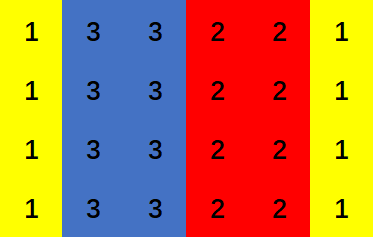
In the third test case, we can color all cells with pigment 1.
在第一个测试用例中,一种可能的解法如下:
在第三个测试用例中,我们可以用颜料 1 给所有格子染色。
输入解题思路,AI测评打分。不知道怎么写?