

CF1677B.Tokitsukaze and Meeting
普及+/提高
通过率:0%
时间限制:1.00s
内存限制:256MB


AC君温馨提醒
该题目为【codeforces】题库的题目,您提交的代码将被提交至codeforces进行远程评测,并由ACGO抓取测评结果后进行展示。由于远程测评的测评机由其他平台提供,我们无法保证该服务的稳定性,若提交后无反应,请等待一段时间后再进行重试。
题目描述
Tokitsukaze is arranging a meeting. There are n rows and m columns of seats in the meeting hall.
There are exactly n⋅m students attending the meeting, including several naughty students and several serious students. The students are numerated from 1 to n⋅m. The students will enter the meeting hall in order. When the i-th student enters the meeting hall, he will sit in the 1-st column of the 1-st row, and the students who are already seated will move back one seat. Specifically, the student sitting in the j-th (1≤j≤m−1) column of the i-th row will move to the (j+1)-th column of the i-th row, and the student sitting in m-th column of the i-th row will move to the 1-st column of the (i+1)-th row.
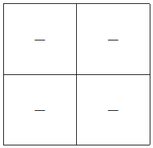
For example, there is a meeting hall with 2 rows and 2 columns of seats shown as below:
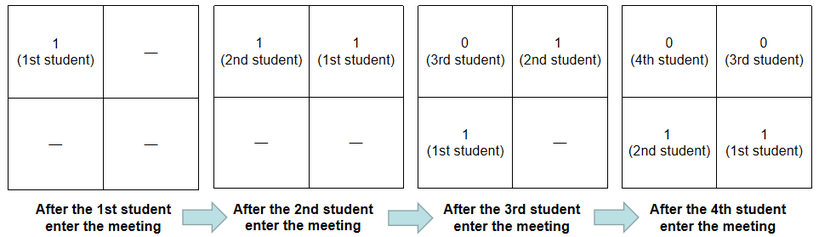
There will be 4 students entering the meeting hall in order, represented as a binary string "1100", of which '0' represents naughty students and '1' represents serious students. The changes of seats in the meeting hall are as follows:
Denote a row or a column good if and only if there is at least one serious student in this row or column. Please predict the number of good rows and columns just after the i-th student enters the meeting hall, for all i.
Tokitsukaze 正在组织一场会议。会议厅共有 n 行 m 列的座位。
恰好有 n⋅m 名学生参加本次会议,其中包括若干名淘气的学生和若干名认真的学生。学生编号从 1 到 n⋅m。学生们将按编号顺序依次进入会议厅。当第 i 名学生进入会议厅时,他将坐在第 1 行第 1 列的位置,而已就座的学生则整体向后移动一个座位。具体而言:位于第 i 行第 j 列(其中 1≤j≤m−1)的学生将移动至第 i 行第 (j+1) 列;而位于第 i 行第 m 列的学生将移动至第 (i+1) 行第 1 列。
例如,下图展示了一个 2 行 2 列的会议厅:
将有 4 名学生按顺序进入会议厅,其类型用二进制字符串 "1100" 表示,其中 '0' 表示淘气的学生,'1' 表示认真的学生。会议厅座位的变化过程如下所示:
若某一行或某一列中至少存在一名认真的学生,则称该行(或该列)为“好”的。请预测:对每个 i,在第 i 名学生进入会议厅之后,会议厅中“好”的行数与“好”的列数分别是多少。
输入格式
The first contains a single positive integer t (1≤t≤10000) — the number of test cases.
For each test case, the first line contains two integers n, m (1≤n,m≤106; 1≤n⋅m≤106), denoting there are n rows and m columns of seats in the meeting hall.
The second line contains a binary string s of length n⋅m, consisting only of zeros and ones. If si equal to '0' represents the i-th student is a naughty student, and si equal to '1' represents the i-th student is a serious student.
It is guaranteed that the sum of n⋅m over all test cases does not exceed 106.
第一行包含一个正整数 t(1≤t≤10000),表示测试用例的数量。
对于每个测试用例,第一行包含两个整数 n、m(1≤n,m≤106;1≤n⋅m≤106),表示会议厅共有 n 行 m 列的座位。
第二行包含一个长度为 n⋅m 的二进制字符串 s,仅由字符 '0' 和 '1' 组成。若 si 为 '0',表示第 i 个学生是调皮的学生;若 si 为 '1',表示第 i 个学生是认真的学生。
保证所有测试用例中 n⋅m 的总和不超过 106。
输出格式
For each test case, print a single line with n⋅m integers — the number of good rows and columns just after the i-th student enters the meeting hall.
对于每个测试用例,输出一行包含 n⋅m 个整数——即第 i 个学生进入会议室后,此时“好”行与“好”列的数量。
输入输出样例
输入#1
3
2 2
1100
4 2
11001101
2 4
11001101
输出#1
2 3 4 3
2 3 4 3 5 4 6 5
2 3 3 3 4 4 4 5
说明/提示
The first test case is shown in the statement.
After the 1-st student enters the meeting hall, there are 2 good rows and columns: the 1-st row and the 1-st column.
After the 2-nd student enters the meeting hall, there are 3 good rows and columns: the 1-st row, the 1-st column and the 2-nd column.
After the 3-rd student enters the meeting hall, the 4 rows and columns are all good.
After the 4-th student enters the meeting hall, there are 3 good rows and columns: the 2-nd row, the 1-st column and the 2-nd column.
第一个测试用例已在题目描述中给出。
在第 1 名学生进入会议室后,有 2 个“好”的行和列:第 1 行和第 1 列。
在第 2 名学生进入会议室后,有 3 个“好”的行和列:第 1 行、第 1 列和第 2 列。
在第 3 名学生进入会议室后,全部 4 行和 4 列均为“好”的行和列。
在第 4 名学生进入会议室后,有 3 个“好”的行和列:第 2 行、第 1 列和第 2 列。
输入解题思路,AI测评打分。不知道怎么写?