

CF1679D.Toss a Coin to Your Graph...
普及+/提高
通过率:0%
时间限制:3.00s
内存限制:256MB


AC君温馨提醒
该题目为【codeforces】题库的题目,您提交的代码将被提交至codeforces进行远程评测,并由ACGO抓取测评结果后进行展示。由于远程测评的测评机由其他平台提供,我们无法保证该服务的稳定性,若提交后无反应,请等待一段时间后再进行重试。
题目描述
One day Masha was walking in the park and found a graph under a tree... Surprised? Did you think that this problem would have some logical and reasoned story? No way! So, the problem...
Masha has an oriented graph which i-th vertex contains some positive integer ai. Initially Masha can put a coin at some vertex. In one operation she can move a coin placed in some vertex u to any other vertex v such that there is an oriented edge u→v in the graph. Each time when the coin is placed in some vertex i, Masha write down an integer ai in her notebook (in particular, when Masha initially puts a coin at some vertex, she writes an integer written at this vertex in her notebook). Masha wants to make exactly k−1 operations in such way that the maximum number written in her notebook is as small as possible.
一天,玛莎在公园散步时在一棵树下发现了一个图……感到惊讶吗?你以为这道题会有一个逻辑清晰、合乎情理的故事背景?才不是呢!所以,题目来了……
玛莎有一个有向图,其中第 i 个顶点上标有一个正整数 ai。初始时,玛莎可以将一枚硬币放在某个顶点上。在一次操作中,她可以将位于顶点 u 上的硬币移动到任意另一个顶点 v,前提是图中存在一条从 u 指向 v 的有向边 u→v。每次硬币被放置在某个顶点 i 上时,玛莎都会将该顶点上的整数 ai 记录在她的笔记本中(特别地,当玛莎最初将硬币放在某个顶点上时,她也会将该顶点上的数记入笔记本)。玛莎希望恰好进行 k−1 次操作,使得她笔记本中记录下的所有数字中的最大值尽可能小。
输入格式
The first line contains three integers n, m and k (1≤n≤2⋅105, 0≤m≤2⋅105, 1≤k≤1018) — the number of vertices and edges in the graph, and the number of operation that Masha should make.
The second line contains n integers ai (1≤ai≤109) — the numbers written in graph vertices.
Each of the following m lines contains two integers u and v (1≤u=v≤n) — it means that there is an edge u→v in the graph.
It's guaranteed that graph doesn't contain self-loops and multi-edges.
第一行包含三个整数 n、m 和 k(1≤n≤2⋅105,0≤m≤2⋅105,1≤k≤1018)—— 分别表示图中顶点数、边数以及玛莎需要执行的操作次数。
第二行包含 n 个整数 ai(1≤ai≤109)—— 表示写在图的各个顶点上的数字。
接下来的 m 行中,每行包含两个整数 u 和 v(1≤u=v≤n)—— 表示图中存在一条从 u 到 v 的有向边。
保证该图不含自环和重边。
输出格式
Print one integer — the minimum value of the maximum number that Masha wrote in her notebook during optimal coin movements.
If Masha won't be able to perform k−1 operations, print −1.
输出一个整数——在最优的硬币移动方案下,玛莎在笔记本中写下的最大数字的最小值。
如果玛莎无法执行 k−1 次操作,则输出 −1。
输入输出样例
输入#1
6 7 4
1 10 2 3 4 5
1 2
1 3
3 4
4 5
5 6
6 2
2 5
输出#1
4
输入#2
6 7 100
1 10 2 3 4 5
1 2
1 3
3 4
4 5
5 6
6 2
2 5
输出#2
10
输入#3
2 1 5
1 1
1 2
输出#3
-1
输入#4
1 0 1
1000000000
输出#4
1000000000
说明/提示
Graph described in the first and the second examples is illustrated below.
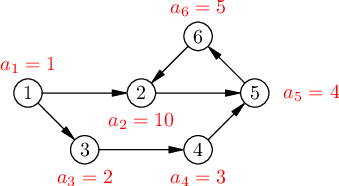
In the first example Masha can initially put a coin at vertex 1. After that she can perform three operations: 1→3, 3→4 and 4→5. Integers 1,2,3 and 4 will be written in the notepad.
In the second example Masha can initially put a coin at vertex 2. After that she can perform 99 operations: 2→5, 5→6, 6→2, 2→5, and so on. Integers 10,4,5,10,4,5,…,10,4,5,10 will be written in the notepad.
In the third example Masha won't be able to perform 4 operations.
第一个和第二个示例中所描述的图如下所示。
在第一个示例中,玛莎最初可将一枚硬币放置在顶点 1 上。之后她可以执行三次操作:1→3、3→4 和 4→5。此时记事本上将依次写下整数 1,2,3 和 4。
在第二个示例中,玛莎最初可将一枚硬币放置在顶点 2 上。之后她可以执行 99 次操作:2→5、5→6、6→2、2→5,依此类推。此时记事本上将依次写下整数 10,4,5,10,4,5,…,10,4,5,10。
在第三个示例中,玛莎无法执行 4 次操作。
输入解题思路,AI测评打分。不知道怎么写?