

CF1654G.Snowy Mountain
省选/NOI-
通过率:0%
时间限制:5.00s
内存限制:1024MB


AC君温馨提醒
该题目为【codeforces】题库的题目,您提交的代码将被提交至codeforces进行远程评测,并由ACGO抓取测评结果后进行展示。由于远程测评的测评机由其他平台提供,我们无法保证该服务的稳定性,若提交后无反应,请等待一段时间后再进行重试。
题目描述
There are n locations on a snowy mountain range (numbered from 1 to n), connected by n−1 trails in the shape of a tree. Each trail has length 1. Some of the locations are base lodges. The height hi of each location is equal to the distance to the nearest base lodge (a base lodge has height 0).
There is a skier at each location, each skier has initial kinetic energy 0. Each skier wants to ski along as many trails as possible. Suppose that the skier is skiing along a trail from location i to j. Skiers are not allowed to ski uphill (i.e., if hi<hj). It costs one unit of kinetic energy to ski along flat ground (i.e., if hi=hj), and a skier gains one unit of kinetic energy by skiing downhill (i.e., if hi>hj). For each location, compute the length of the longest sequence of trails that the skier starting at that location can ski along without their kinetic energy ever becoming negative. Skiers are allowed to visit the same location or trail multiple times.
一座被积雪覆盖的山脉上有 n 个地点(编号为 1 到 n),这些地点通过 n−1 条小径相连,构成一棵树。每条小径的长度均为 1。其中部分地点是山脚旅馆。每个地点 i 的高度 hi 定义为该地点到最近的山脚旅馆的距离(山脚旅馆自身的高度为 0)。
每个地点上都有一名滑雪者,且初始动能均为 0。每位滑雪者希望尽可能多地滑行经过小径。假设某滑雪者正沿一条从小径一端地点 i 滑向另一端地点 j。滑雪者不允许向上坡滑行(即若 hi<hj,则禁止滑行)。在平地上滑行(即 hi=hj)消耗 1 单位动能;而向下滑行(即 hi>hj)则获得 1 单位动能。对每个地点,请计算:从该地点出发的滑雪者,在其动能始终不为负的前提下,所能滑行的最长小径序列的长度(即经过的小径条数)。滑雪者可以多次访问同一地点或同一条小径。
输入格式
The first line contains a single integer n (2≤n≤2⋅105).
The second line contains n integers l1,l2,…,ln (0≤li≤1). If li=1, location i is a base lodge; if li=0, location i is not a base lodge. It is guaranteed that there is at least 1 base lodge.
Each of the next n−1 lines contains two integers u,v (1≤u,v≤n, u=v), meaning that there is a trail that connects the locations u and v. It is guaranteed that the given trails form a tree.
第一行包含一个整数 n(2≤n≤2⋅105)。
第二行包含 n 个整数 l1,l2,…,ln(0≤li≤1)。若 li=1,则位置 i 是一个基地小屋;若 li=0,则位置 i 不是基地小屋。保证至少存在 1 个基地小屋。
接下来的 n−1 行中,每行包含两个整数 u,v(1≤u,v≤n,且 u=v),表示存在一条连接位置 u 和 v 的小径。保证所给的小径构成一棵树。
输出格式
Print n integers: the i-th integer is equal to the length of the longest sequence of trails that the skier starting at location i can ski along without their kinetic energy ever becoming negative.
输出 n 个整数:第 i 个整数等于滑雪者从位置 i 出发,在动能始终不为负的前提下,所能滑行的最长路径序列的长度。
输入输出样例
输入#1
6
1 1 0 0 0 0
1 3
2 4
3 4
4 5
5 6
输出#1
0 0 1 1 3 5
输入#2
9
0 0 0 0 0 0 1 1 1
1 3
2 3
2 5
3 6
4 5
4 7
5 8
6 9
输出#2
5 3 2 1 1 1 0 0 0
输入#3
14
0 0 0 0 0 0 0 0 0 1 1 1 1 1
1 2
2 5
3 4
4 5
3 6
4 8
5 9
7 8
6 11
7 12
8 13
9 14
10 11
输出#3
8 5 4 3 2 2 1 1 1 0 0 0 0 0
输入#4
20
0 0 0 0 0 0 0 0 0 0 0 0 0 1 1 1 0 1 0 1
17 3
11 12
6 10
18 19
8 14
16 20
5 3
2 11
7 10
2 15
8 3
3 15
9 16
7 13
16 1
19 2
2 16
6 1
4 17
输出#4
2 2 1 5 3 4 8 1 2 6 4 6 10 0 0 0 3 0 1 0
说明/提示
In the first test, h=[0,0,1,1,2,3]. The skier starting from 6 can ski along at most 5 trails, in the path 6→5→4→3→4→2 (notice that a skier can ski multiple times along the same trail and can visit more than once the same location):
- at the location 6, the kinetic energy is 0;
- at the location 5, the kinetic energy increases by 1 (because h5<h6), so it becomes 1;
- at the location 4, the kinetic energy increases by 1 (because h4<h5), so it becomes 2;
- at the location 3, the kinetic energy decreases by 1 (because h3=h4), so it becomes 1;
- at the location 4, the kinetic energy decreases by 1 (because h4=h3), so it becomes 0;
- at the location 2, the kinetic energy increases by 1 (because h2<h4), so it becomes 1.
There isn't any sequence of trails of length greater than 5 such that the kinetic energy is always non-negative.
Moreover,
- the optimal path for the skier starting from 1 is 1 (no trails);
- the optimal path for the skier starting from 2 is 2 (no trails);
- the optimal path for the skier starting from 3 is 3→1;
- the optimal path for the skier starting from 4 is 4→2;
- the optimal path for the skier starting from 5 is 5→4→3→1.
In the second test, h=[3,2,2,1,1,1,0,0,0]. The skier starting from 1 can ski along at most 5 trails, in the path 1→3→2→5→4→7.
- at the location 1, the kinetic energy is 0;
- at the location 3, the kinetic energy increases by 1 (because h3<h1), so it becomes 1;
- at the location 2, the kinetic energy decreases by 1 (because h2=h3), so it becomes 0;
- at the location 5, the kinetic energy increases by 1 (because h5<h2), so it becomes 1;
- at the location 4, the kinetic energy decreases by 1 (because h4=h5), so it becomes 0;
- at the location 7, the kinetic energy increases by 1 (because h7<h4), so it becomes 1.
There isn't any sequence of trails of length greater than 5 such that the kinetic energy is always non-negative.
In the third test, for the skier starting from vertex 1, the optimal path is 1→2→5→4→3→6→11→10→11.
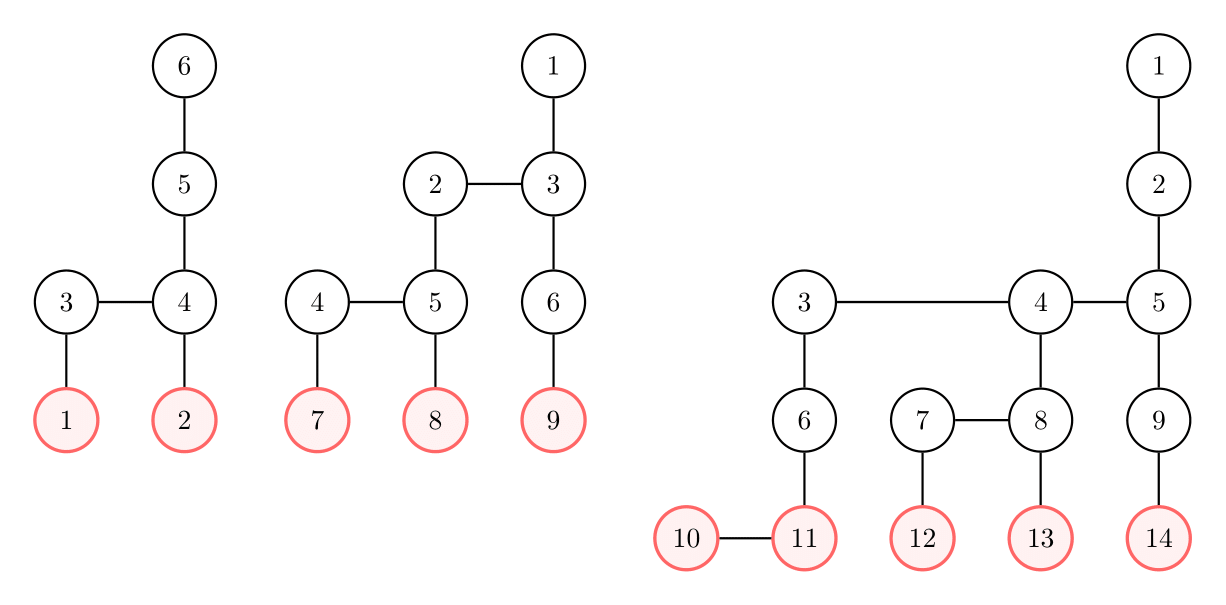
Here are pictures of the first, second, and third test, with the base lodges shown in red:
在第一个测试中,h=[0,0,1,1,2,3]。从位置 6 出发的滑雪者最多可沿 5 条滑道滑行,路径为 6→5→4→3→4→2(注意:滑雪者可多次沿同一条滑道滑行,也可多次访问同一位置):
- 在位置 6,动能为 0;
- 在位置 5,动能增加 1(因为 h5<h6),变为 1;
- 在位置 4,动能增加 1(因为 h4<h5),变为 2;
- 在位置 3,动能减少 1(因为 h3=h4),变为 1;
- 在位置 4,动能减少 1(因为 h4=h3),变为 0;
- 在位置 2,动能增加 1(因为 h2<h4),变为 1。
不存在长度大于 5 的滑道序列,使得全程动能始终非负。
此外,
- 从位置 1 出发的滑雪者的最优路径为 1(不经过任何滑道);
- 从位置 2 出发的滑雪者的最优路径为 2(不经过任何滑道);
- 从位置 3 出发的滑雪者的最优路径为 3→1;
- 从位置 4 出发的滑雪者的最优路径为 4→2;
- 从位置 5 出发的滑雪者的最优路径为 5→4→3→1。
在第二个测试中,h=[3,2,2,1,1,1,0,0,0]。从位置 1 出发的滑雪者最多可沿 5 条滑道滑行,路径为 1→3→2→5→4→7。
- 在位置 1,动能为 0;
- 在位置 3,动能增加 1(因为 h3<h1),变为 1;
- 在位置 2,动能减少 1(因为 h2=h3),变为 0;
- 在位置 5,动能增加 1(因为 h5<h2),变为 1;
- 在位置 4,动能减少 1(因为 h4=h5),变为 0;
- 在位置 7,动能增加 1(因为 h7<h4),变为 1。
不存在长度大于 5 的滑道序列,使得全程动能始终非负。
在第三个测试中,从顶点 1 出发的滑雪者的最优路径为 1→2→5→4→3→6→11→10→11。
以下是第一、第二和第三个测试的示意图,其中基础小屋以红色标出:
输入解题思路,AI测评打分。不知道怎么写?