

AT_arc226_e.Cellular Messenger
NOI/NOI+/CTSC
通过率:0%
时间限制:2.00s
内存限制:1024MB


AC君温馨提醒
该题目为【atcoder】题库的题目,您提交的代码将被提交至atcoder进行远程评测,并由ACGO抓取测评结果后进行展示。由于远程测评的测评机由其他平台提供,我们无法保证该服务的稳定性,若提交后无反应,请等待一段时间后再进行重试。
题目描述
Snuke wants to design a cellular automaton that conveys a binary sequence, written into a certain cell over N turns, to a distant cell.
1. Grid
There is an infinitely large grid. Each cell has a state of 0 or 1.
Let some row of the grid be row 0 and some column be column 0, with row numbers increasing by 1 downward and column numbers increasing by 1 to the right. Let (r,c) denote the coordinates of the cell at row r and column c. The coordinates of the cells are as shown in the figure below.
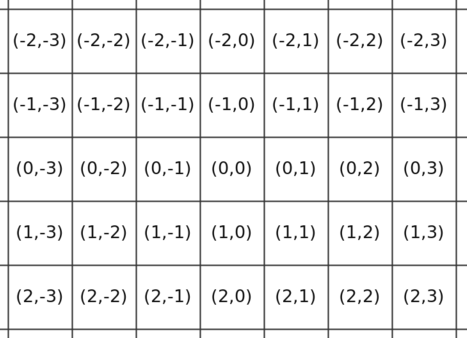
The cells adjacent to a given cell refer to the eight cells sharing an edge or a vertex with it.
You may choose a rectangular region satisfying the following conditions, and freely set the initial states of the cells within the region.
- Both the height H and the width W are between 1 and 150, inclusive.
- The coordinates of the top-left cell are (0,0).
The initial states of all cells outside the region are 0.
2. Update Operation
Decide on a value Fi,j, either 0 or 1, for each i=0,1 and j=0,1,…,8; let these values be the update rule. However, F0,0=0 must hold.
In the update operation, the states of all cells are updated simultaneously. For a given cell, let i be its state before the update and j be the sum of the states of the eight adjacent cells; then its state after the update is Fi,j.
3. Designing the Automaton
You need to decide on and output the following values.
- The update rule Fi,j (i=0,1) (0≤j≤8)
- F0,0=0 must hold.
- The height H and width W of the rectangular region for which the initial state is set
- Both H and W must be between 1 and 150, inclusive.
- The initial states Ar,c (0≤r<H) (0≤c<W) within the rectangular region
- The coordinates (Rs,Cs) of the sending cell and (Rt,Ct) of the receiving cell
- 0≤Rs,Rt<H and 0≤Cs,Ct<W must hold.
- 50≤∣Cs−Ct∣≤100 must hold.
- The delay D from sending to receiving
- It must be possible to read, at the receiving cell on turn k+D−1, the value that was written to the sending cell on turn k.
- 50≤D≤100 must hold.
4. Judging Method
Judging is performed as follows.
-
Decide on a positive integer N and a sequence S=(S1,S2,…,SN) of length N consisting of 0s and 1s. These are fixed for each test case.
-
Receive the design of the automaton that you output.
-
Prepare an empty sequence T, and simulate N+D−1 turns starting from the initial state. Specifically, for each k=1,2,…,N+D−1, perform the following steps in order on turn k.
- If k≤N, change the state of the sending cell (Rs,Cs) to Sk.
- Perform one update operation on the grid.
- If D≤k<D+N, append the state of the receiving cell (Rt,Ct) to the end of T.
-
After the simulation ends, if S=T, your output is judged correct; otherwise, it is judged incorrect.
It is guaranteed that there exists a design of the automaton that is judged correct regardless of N and S, but due to implementation details of the judge for this problem, N and S are fixed for each test case file, and only cases with N≤300 are used.
すぬけさんは、N ターンにわたってある特定のセルに書き込まれた 0/1 の列を、遠く離れた別のセルへと伝達するセルオートマトンを設計したいと考えています。
1.グリッド
無限に広いグリッドが存在します。各セルの状態は 0 または 1 のいずれかです。
グリッドの適当な行を「行 0」、適当な列を「列 0」とし、行番号は下方向に 1 ずつ増加し、列番号は右方向に 1 ずつ増加するものとします。(r,c) は、行 r、列 c にあるセルの座標を表します。セルの座標は以下の図の通りです。
あるセルの「隣接セル」とは、そのセルと辺または頂点を共有する 8 個のセルを指します。
以下の条件を満たす長方形領域を自由に選び、その領域内のセルの初期状態を任意に設定できます。
- 高さ H および幅 W はともに 1 以上 150 以下(両端含む)である。
- 左上角のセルの座標は (0,0) である。
領域外のすべてのセルの初期状態は 0 です。
2.更新操作
各 i=0,1 および j=0,1,…,8 に対して値 Fi,j∈{0,1} を定め、これを更新規則と呼びます。ただし、F0,0=0 でなければなりません。
更新操作では、すべてのセルの状態が同時に更新されます。あるセルについて、更新前の状態を i、その 8 個の隣接セルの状態の和を j とするとき、更新後の状態は Fi,j となります。
3.オートマトンの設計
以下の値を決定し、出力する必要があります。
- 更新規則 Fi,j(i=0,1,0≤j≤8)
- F0,0=0 を満たさなければならない。
- 初期状態を設定する長方形領域の高さ H および幅 W
- H および W はともに 1 以上 150 以下(両端含む)でなければならない。
- 長方形領域内の初期状態 Ar,c(0≤r<H,0≤c<W)
- 送信セルの座標 (Rs,Cs) および 受信セルの座標 (Rt,Ct)
- 0≤Rs,Rt<H かつ 0≤Cs,Ct<W を満たさなければならない。
- 50≤∣Cs−Ct∣≤100 を満たさなければならない。
- 送信から受信までの遅延 D
- ターン k に送信セル (Rs,Cs) に書き込まれた値が、ターン k+D−1 に受信セル (Rt,Ct) で読み取れることを保証しなければならない。
- 50≤D≤100 を満たさなければならない。
4.判定方法
判定は以下のように行われます。
-
正の整数 N および長さ N の 0/1 列 S=(S1,S2,…,SN) を決定します。これらは各テストケースごとに固定されます。
-
あなたが出力したオートマトンの設計を受け取ります。
-
空の列 T を用意し、初期状態から N+D−1 ターンのシミュレーションを行います。具体的には、各 k=1,2,…,N+D−1 について、ターン k において以下の手順を順に行います。
- k≤N ならば、送信セル (Rs,Cs) の状態を Sk に変更する。
- グリッド全体に対して 1 回の更新操作を行う。
- D≤k<D+N ならば、受信セル (Rt,Ct) の状態を T の末尾に追加する。
-
シミュレーション終了後、S=T が成り立てば正解と判定され、そうでなければ不正解と判定されます。
任意の N および S に対しても正解となるようなオートマトンの設計が必ず存在することが保証されていますが、本問題のジャッジ実装の都合上、各テストケースファイルにおいて N および S は固定されており、また N≤300 のみが使用されます。
输入格式
This problem provides no input.
本题不提供输入。
输出格式
Output in the following format:
F0,0F0,1…F0,8
F1,0F1,1…F1,8
H W
A0,0A0,1…A0,W−1
A1,0A1,1…A1,W−1
⋮
AH−1,0AH−1,1…AH−1,W−1
Rs Cs Rt Ct D
Your output must satisfy the following conditions.
- Fi,j∈0,1
- F0,0=0
- 1≤H,W≤150
- Ar,c∈0,1
- 0≤Rs,Rt<H
- 0≤Cs,Ct<W
- 50≤∣Cs−Ct∣≤100
- 50≤D≤100
If your output satisfies the above conditions, and is judged correct by the judging method described above for all prepared test cases, this problem is considered solved.
按以下格式输出:
F0,0F0,1…F0,8
F1,0F1,1…F1,8
H W
A0,0A0,1…A0,W−1
A1,0A1,1…A1,W−1
⋮
AH−1,0AH−1,1…AH−1,W−1
Rs Cs Rt Ct D
你的输出必须满足以下条件:
- Fi,j∈{0,1}
- F0,0=0
- 1≤H,W≤150
- Ar,c∈{0,1}
- 0≤Rs,Rt<H
- 0≤Cs,Ct<W
- 50≤∣Cs−Ct∣≤100
- 50≤D≤100
若你的输出满足上述所有条件,且对所有预设测试用例均能通过前述评测方法判定为正确,则本题视为解答成功。
说明/提示
Visualizer
You can check the behavior of your automaton using the visualizer.
Constraints
- The N used by the judge is between 1 and 300, inclusive.
可视化工具
你可以使用 可视化工具 来检查你的自动机的行为。
限制条件
- 评测所用的 N 在 1 到 300(含)之间。
输入解题思路,AI测评打分。不知道怎么写?