

CF1615E.Purple Crayon
提高+/省选-
通过率:0%
时间限制:2.00s
内存限制:256MB


AC君温馨提醒
该题目为【codeforces】题库的题目,您提交的代码将被提交至codeforces进行远程评测,并由ACGO抓取测评结果后进行展示。由于远程测评的测评机由其他平台提供,我们无法保证该服务的稳定性,若提交后无反应,请等待一段时间后再进行重试。
题目描述
Two players, Red and Blue, are at it again, and this time they're playing with crayons! The mischievous duo is now vandalizing a rooted tree, by coloring the nodes while playing their favorite game.
The game works as follows: there is a tree of size n, rooted at node 1, where each node is initially white. Red and Blue get one turn each. Red goes first.
In Red's turn, he can do the following operation any number of times:
- Pick any subtree of the rooted tree, and color every node in the subtree red.
However, to make the game fair, Red is only allowed to color k nodes of the tree. In other words, after Red's turn, at most k of the nodes can be colored red.
Then, it's Blue's turn. Blue can do the following operation any number of times:
- Pick any subtree of the rooted tree, and color every node in the subtree blue. However, he's not allowed to choose a subtree that contains a node already colored red, as that would make the node purple and no one likes purple crayon.
Note: there's no restriction on the number of nodes Blue can color, as long as he doesn't color a node that Red has already colored.
After the two turns, the score of the game is determined as follows: let w be the number of white nodes, r be the number of red nodes, and b be the number of blue nodes. The score of the game is w⋅(r−b).
Red wants to maximize this score, and Blue wants to minimize it. If both players play optimally, what will the final score of the game be?
两名玩家——红方与蓝方——再次展开较量,而这一次他们使用蜡笔进行游戏!这对顽皮的搭档正在破坏一棵有根树,通过为节点着色来玩他们最喜爱的游戏。
游戏规则如下:给定一棵大小为 n 的有根树,根节点为节点 1,初始时所有节点均为白色。红方与蓝方各进行一次回合,红方先行。
在红方的回合中,他可以执行以下操作任意多次:
- 任选该有根树的一棵子树,并将该子树中所有节点染成红色。
然而,为使游戏公平,红方总共至多只能染色 k 个节点。换言之,红方回合结束后,至多有 k 个节点被染成红色。
随后轮到蓝方行动。蓝方可以执行以下操作任意多次:
- 任选该有根树的一棵子树,并将该子树中所有节点染成蓝色。但蓝方不得选择包含任何已被染成红色节点的子树,因为那样会使该节点变成紫色,而没人喜欢紫色蜡笔。
注意:只要不染色已被红方染红的节点,蓝方对可染色的节点总数没有限制。
两回合结束后,游戏得分按如下方式计算:设 w 为白色节点数,r 为红色节点数,b 为蓝色节点数,则游戏得分为 w⋅(r−b)。
红方希望最大化该得分,蓝方则希望最小化该得分。若双方均采取最优策略,最终游戏得分是多少?
输入格式
The first line contains two integers n and k (2≤n≤2⋅105; 1≤k≤n) — the number of vertices in the tree and the maximum number of red nodes.
Next n−1 lines contains description of edges. The i-th line contains two space separated integers ui and vi (1≤ui,vi≤n; ui=vi) — the i-th edge of the tree.
It's guaranteed that given edges form a tree.
第一行包含两个整数 n 和 k(2≤n≤2⋅105;1≤k≤n)—— 分别表示树中顶点的数量以及红色节点的最大数量。
接下来的 n−1 行描述树的边。第 i 行包含两个以空格分隔的整数 ui 和 vi(1≤ui,vi≤n;ui=vi)—— 表示树的第 i 条边。
保证所给的边构成一棵树。
输出格式
Print one integer — the resulting score if both Red and Blue play optimally.
输出一个整数——当红方和蓝方均采取最优策略时的最终得分。
输入输出样例
输入#1
4 2
1 2
1 3
1 4
输出#1
1
输入#2
5 2
1 2
2 3
3 4
4 5
输出#2
6
输入#3
7 2
1 2
1 3
4 2
3 5
6 3
6 7
输出#3
4
输入#4
4 1
1 2
1 3
1 4
输出#4
-1
说明/提示
In the first test case, the optimal strategy is as follows:
- Red chooses to color the subtrees of nodes 2 and 3.
- Blue chooses to color the subtree of node 4.
At the end of this process, nodes 2 and 3 are red, node 4 is blue, and node 1 is white. The score of the game is 1⋅(2−1)=1.
In the second test case, the optimal strategy is as follows:
- Red chooses to color the subtree of node 4. This colors both nodes 4 and 5.
- Blue does not have any options, so nothing is colored blue.
At the end of this process, nodes 4 and 5 are red, and nodes 1, 2 and 3 are white. The score of the game is 3⋅(2−0)=6.
For the third test case:
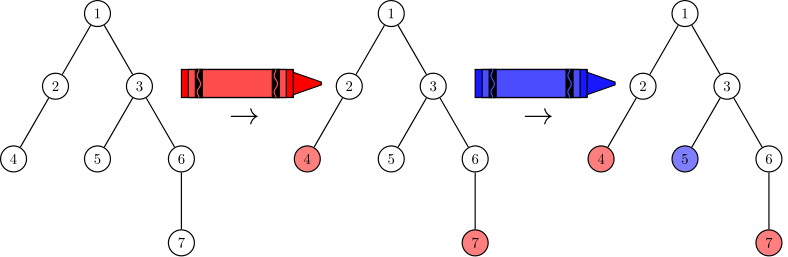
The score of the game is 4⋅(2−1)=4.
在第一个测试用例中,最优策略如下:
- 红方选择为节点 2 和 3 的子树着色。
- 蓝方选择为节点 4 的子树着色。
该过程结束后,节点 2 和 3 为红色,节点 4 为蓝色,节点 1 为白色。游戏得分为 1⋅(2−1)=1。
在第二个测试用例中,最优策略如下:
- 红方选择为节点 4 的子树着色。这将同时为节点 4 和 5 着色。
- 蓝方没有任何可选操作,因此没有节点被着为蓝色。
该过程结束后,节点 4 和 5 为红色,节点 1、2 和 3 为白色。游戏得分为 3⋅(2−0)=6。
对于第三个测试用例:
游戏得分为 4⋅(2−1)=4。
输入解题思路,AI测评打分。不知道怎么写?