

CF1572E.Polygon
NOI/NOI+/CTSC
通过率:0%
时间限制:3.00s
内存限制:256MB


AC君温馨提醒
该题目为【codeforces】题库的题目,您提交的代码将被提交至codeforces进行远程评测,并由ACGO抓取测评结果后进行展示。由于远程测评的测评机由其他平台提供,我们无法保证该服务的稳定性,若提交后无反应,请等待一段时间后再进行重试。
题目描述
You are given a strictly convex polygon with n vertices.
You will make k cuts that meet the following conditions:
- each cut is a segment that connects two different nonadjacent vertices;
- two cuts can intersect only at vertices of the polygon.
Your task is to maximize the area of the smallest region that will be formed by the polygon and those k cuts.
给你一个具有 n 个顶点的严格凸多边形。
你将进行 k 次切割,这些切割需满足以下条件:
- 每次切割是一条连接两个不同且不相邻顶点的线段;
- 任意两条切割线段仅可在多边形的顶点处相交。
你的任务是最大化该多边形与这 k 条切割线所划分出的所有区域中,面积最小的那个区域的面积。
输入格式
The first line contains two integers n, k (3≤n≤200, 0≤k≤n−3).
The following n lines describe vertices of the polygon in anticlockwise direction. The i-th line contains two integers xi, yi (∣xi∣,∣yi∣≤108) — the coordinates of the i-th vertex.
It is guaranteed that the polygon is convex and that no two adjacent sides are parallel.
第一行包含两个整数 n 和 k(3≤n≤200,0≤k≤n−3)。
接下来的 n 行按逆时针顺序描述多边形的顶点。第 i 行包含两个整数 xi、yi(∣xi∣,∣yi∣≤108),表示第 i 个顶点的坐标。
保证该多边形为凸多边形,且任意两条相邻边均不平行。
输出格式
Print one integer: the maximum possible area of the smallest region after making k cuts multiplied by 2.
输出一个整数:进行 k 次切割后,最小区域的最大可能面积乘以 2。
输入输出样例
输入#1
8 4
-2 -4
2 -2
4 2
1 5
0 5
-4 4
-5 0
-5 -1
输出#1
11
输入#2
6 3
2 -2
2 -1
1 2
0 2
-2 1
-1 0
输出#2
3
说明/提示
In the first example, it's optimal to make cuts between the following pairs of vertices:
- (−2,−4) and (4,2),
- (−2,−4) and (1,5),
- (−5,−1) and (1,5),
- (−5,0) and (0,5).
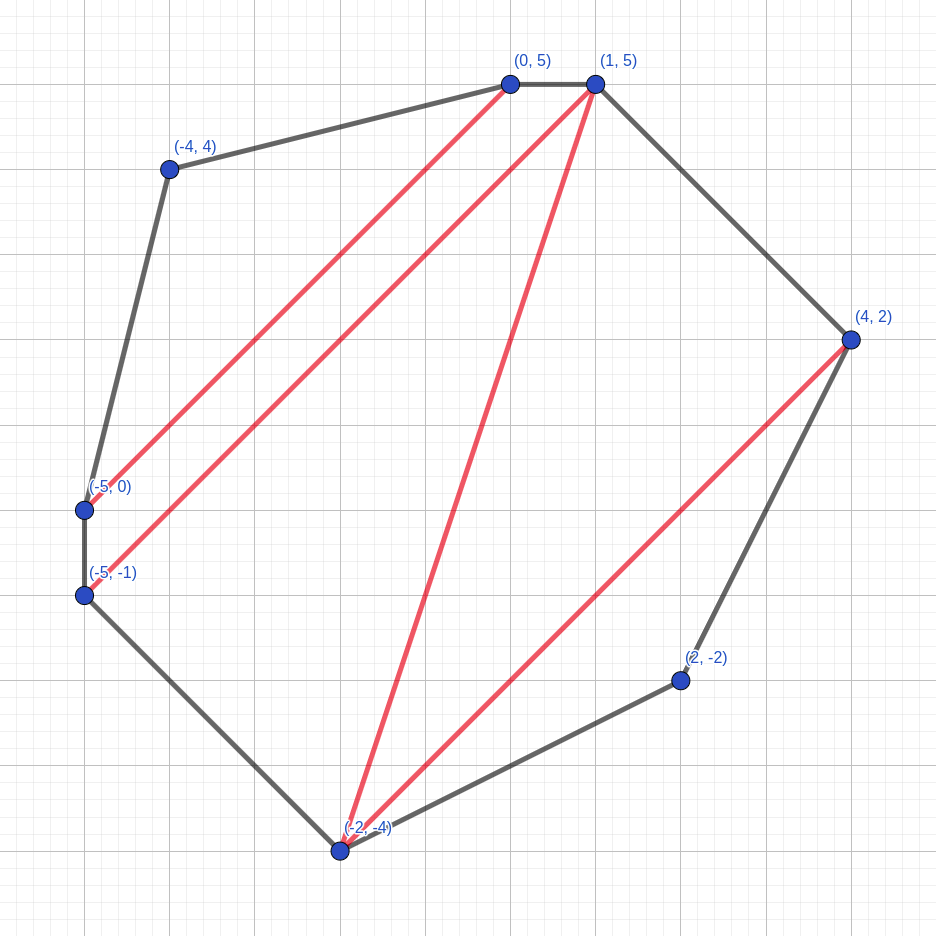 Points (−5,−1), (1,5), (0,5), (−5,0) determine the smallest region with double area of 11.
In the second example, it's optimal to make cuts between the following pairs of vertices:
- (2,−1) and (0,2),
- (2,−1) and (1,0),
- (−1,0) and (0,2).
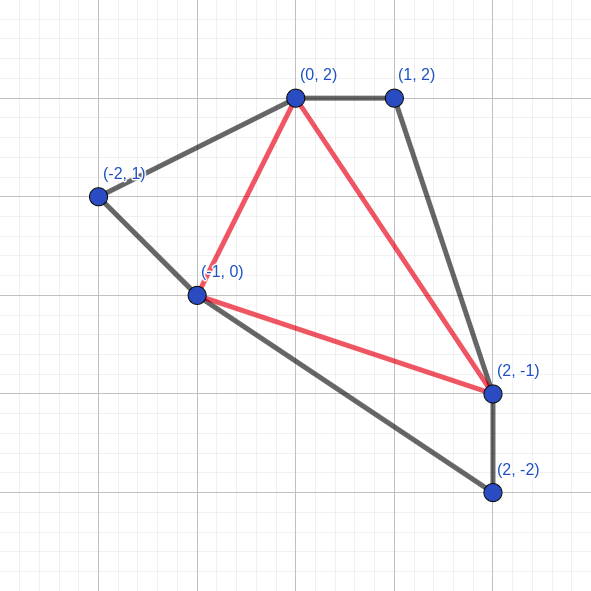 Points (2,−2), (2,−1), (−1,0) determine one of the smallest regions with double area of 3.
在第一个例子中,最优的切割位于以下顶点对之间:
- (−2,−4) 和 (4,2),
- (−2,−4) 和 (1,5),
- (−5,−1) 和 (1,5),
- (−5,0) 和 (0,5)。
点 (−5,−1)、(1,5)、(0,5)、(−5,0) 构成面积最小的区域之一,其两倍面积为 11。
在第二个例子中,最优的切割位于以下顶点对之间:
- (2,−1) 和 (0,2),
- (2,−1) 和 (1,0),
- (−1,0) 和 (0,2)。
点 (2,−2)、(2,−1)、(−1,0) 构成面积最小的区域之一,其两倍面积为 3。
输入解题思路,AI测评打分。不知道怎么写?