

CF1547G.How Many Paths?
提高+/省选-
通过率:0%
时间限制:4.00s
内存限制:512MB


AC君温馨提醒
该题目为【codeforces】题库的题目,您提交的代码将被提交至codeforces进行远程评测,并由ACGO抓取测评结果后进行展示。由于远程测评的测评机由其他平台提供,我们无法保证该服务的稳定性,若提交后无反应,请等待一段时间后再进行重试。
题目描述
You are given a directed graph G which can contain loops (edges from a vertex to itself). Multi-edges are absent in G which means that for all ordered pairs (u,v) exists at most one edge from u to v. Vertices are numbered from 1 to n.
A path from u to v is a sequence of edges such that:
- vertex u is the start of the first edge in the path;
- vertex v is the end of the last edge in the path;
- for all pairs of adjacent edges next edge starts at the vertex that the previous edge ends on.
We will assume that the empty sequence of edges is a path from u to u.
For each vertex v output one of four values:
- 0, if there are no paths from 1 to v;
- 1, if there is only one path from 1 to v;
- 2, if there is more than one path from 1 to v and the number of paths is finite;
- −1, if the number of paths from 1 to v is infinite.
Let's look at the example shown in the figure.
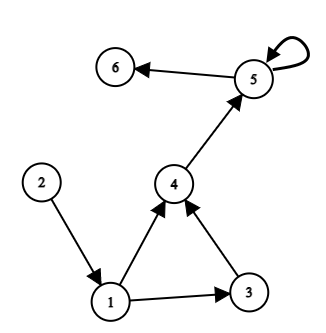
Then:
- the answer for vertex 1 is 1: there is only one path from 1 to 1 (path with length 0);
- the answer for vertex 2 is 0: there are no paths from 1 to 2;
- the answer for vertex 3 is 1: there is only one path from 1 to 3 (it is the edge (1,3));
- the answer for vertex 4 is 2: there are more than one paths from 1 to 4 and the number of paths are finite (two paths: [(1,3),(3,4)] and [(1,4)]);
- the answer for vertex 5 is −1: the number of paths from 1 to 5 is infinite (the loop can be used in a path many times);
- the answer for vertex 6 is −1: the number of paths from 1 to 6 is infinite (the loop can be used in a path many times).
给你一个有向图 G,其中可能包含自环(即从一个顶点指向其自身的边)。图 G 中不存在重边,这意味着对任意有序顶点对 (u,v),至多存在一条从 u 到 v 的边。顶点编号为 1 到 n。
从 u 到 v 的一条路径是指满足以下条件的一条边序列:
- 顶点 u 是该路径中第一条边的起点;
- 顶点 v 是该路径中最后一条边的终点;
- 对于任意相邻的两条边,后一条边的起点等于前一条边的终点。
我们约定:空边序列是顶点 u 到自身的一条路径(即长度为 0 的路径)。
对每个顶点 v,输出以下四个值之一:
- 0:若不存在从 1 到 v 的路径;
- 1:若恰好存在一条从 1 到 v 的路径;
- 2:若存在多于一条从 1 到 v 的路径,且路径总数有限;
- −1:若从 1 到 v 的路径数量无限。
请参考下图所示示例:
则:
- 顶点 1 的答案为 1:仅存在一条从 1 到 1 的路径(即长度为 0 的空路径);
- 顶点 2 的答案为 0:不存在从 1 到 2 的路径;
- 顶点 3 的答案为 1:仅存在一条从 1 到 3 的路径(即边 (1,3));
- 顶点 4 的答案为 2:存在多于一条从 1 到 4 的路径,且路径总数有限(共两条:[(1,3),(3,4)] 和 [(1,4)]);
- 顶点 5 的答案为 −1:从 1 到 5 的路径数量无限(可在路径中多次使用该自环);
- 顶点 6 的答案为 −1:从 1 到 6 的路径数量无限(可在路径中多次使用该自环)。
输入格式
The first contains an integer t (1≤t≤104) — the number of test cases in the input. Then t test cases follow. Before each test case, there is an empty line.
The first line of the test case contains two integers n and m (1≤n≤4⋅105,0≤m≤4⋅105) — numbers of vertices and edges in graph respectively. The next m lines contain edges descriptions. Each line contains two integers ai, bi (1≤ai,bi≤n) — the start and the end of the i-th edge. The vertices of the graph are numbered from 1 to n. The given graph can contain loops (it is possible that ai=bi), but cannot contain multi-edges (it is not possible that ai=aj and bi=bj for i=j).
The sum of n over all test cases does not exceed 4⋅105. Similarly, the sum of m over all test cases does not exceed 4⋅105.
第一行包含一个整数 t(1≤t≤104)—— 表示输入中测试用例的数量。随后是 t 个测试用例。每个测试用例之前均有一空行。
每个测试用例的第一行包含两个整数 n 和 m(1≤n≤4⋅105, 0≤m≤4⋅105)—— 分别表示图中的顶点数和边数。接下来的 m 行描述各条边,每行包含两个整数 ai、bi(1≤ai,bi≤n)—— 表示第 i 条边的起点与终点。图中顶点编号为 1 到 n。所给图可包含自环(即可能出现 ai=bi),但不能包含重边(即对任意 i=j,不可能同时满足 ai=aj 且 bi=bj)。
所有测试用例的 n 之和不超过 4⋅105;同理,所有测试用例的 m 之和也不超过 4⋅105。
输出格式
Output t lines. The i-th line should contain an answer for the i-th test case: a sequence of n integers from −1 to 2.
输出 t 行。第 i 行应包含第 i 个测试用例的答案:一个由 n 个整数组成的序列,每个整数取值范围为 −1 到 2(含端点)。
输入输出样例
输入#1
5

6 7
1 4
1 3
3 4
4 5
2 1
5 5
5 6

1 0

3 3
1 2
2 3
3 1

5 0

4 4
1 2
2 3
1 4
4 3
输出#1
1 0 1 2 -1 -1
1
-1 -1 -1
1 0 0 0 0
1 1 2 1
输入解题思路,AI测评打分。不知道怎么写?