

CF1527D.MEX Tree
提高+/省选-
通过率:0%
时间限制:1.50s
内存限制:256MB


AC君温馨提醒
该题目为【codeforces】题库的题目,您提交的代码将被提交至codeforces进行远程评测,并由ACGO抓取测评结果后进行展示。由于远程测评的测评机由其他平台提供,我们无法保证该服务的稳定性,若提交后无反应,请等待一段时间后再进行重试。
题目描述
You are given a tree with n nodes, numerated from 0 to n−1. For each k between 0 and n, inclusive, you have to count the number of unordered pairs (u,v), u=v, such that the MEX of all the node labels in the shortest path from u to v (including end points) is k.
The MEX of a sequence of integers is the smallest non-negative integer that does not belong to the sequence.
给你一棵包含 n 个节点的树,节点编号从 0 到 n−1。对于每个在 0 到 n(含)之间的整数 k,你需要计算满足以下条件的无序对 (u,v)(其中 u=v)的数目:从 u 到 v 的最短路径(包含端点)上所有节点标签所构成序列的 MEX 值恰好为 k。
一个整数序列的 MEX(minimum excluded value)是指不属于该序列的最小非负整数。
输入格式
The first line contains a single integer t (1≤t≤104) — the number of test cases.
The first line of each test case contains a single integer n (2≤n≤2⋅105).
The next n−1 lines of each test case describe the tree that has to be constructed. These lines contain two integers u and v (0≤u,v≤n−1) denoting an edge between u and v (u=v).
It is guaranteed that the given edges form a tree.
It is also guaranteed that the sum of n for all test cases does not exceed 2⋅105.
第一行包含一个整数 t(1≤t≤104)—— 表示测试用例的数量。
每个测试用例的第一行包含一个整数 n(2≤n≤2⋅105)。
每个测试用例的接下来 n−1 行描述了需要构建的树。每行包含两个整数 u 和 v(0≤u,v≤n−1),表示节点 u 与 v 之间存在一条边(u=v)。
保证所给的边构成一棵树。
还保证所有测试用例的 n 值之和不超过 2⋅105。
输出格式
For each test case, print n+1 integers: the number of paths in the tree, such that the MEX of all the node labels in that path is k for each k from 0 to n.
对于每个测试用例,输出 n+1 个整数:对于每个从 0 到 n 的 k,输出树中满足该路径上所有节点标签的 MEX 值恰好为 k 的路径数量。
输入输出样例
输入#1
2
4
0 1
0 2
2 3
2
1 0
输出#1
1 2 1 1 1
0 0 1
说明/提示
-
In example case 1,
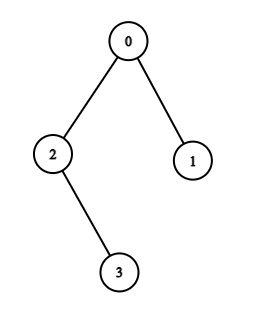
- For k=0, there is 1 path that is from 2 to 3 as MEX([2,3])=0.
- For k=1, there are 2 paths that is from 0 to 2 as MEX([0,2])=1 and 0 to 3 as MEX([0,2,3])=1.
- For k=2, there is 1 path that is from 0 to 1 as MEX([0,1])=2.
- For k=3, there is 1 path that is from 1 to 2 as MEX([1,0,2])=3
- For k=4, there is 1 path that is from 1 to 3 as MEX([1,0,2,3])=4.
-
In example case 2,
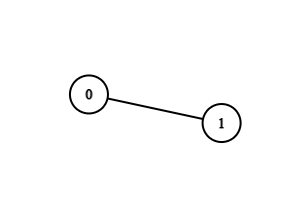
- For k=0, there are no such paths.
- For k=1, there are no such paths.
- For k=2, there is 1 path that is from 0 to 1 as MEX([0,1])=2.
-
在样例 1 中,
- 当 k=0 时,存在 1 条路径:从节点 2 到节点 3,因为 MEX([2,3])=0。
- 当 k=1 时,存在 2 条路径:从节点 0 到节点 2,因为 MEX([0,2])=1;以及从节点 0 到节点 3,因为 MEX([0,2,3])=1。
- 当 k=2 时,存在 1 条路径:从节点 0 到节点 1,因为 MEX([0,1])=2。
- 当 k=3 时,存在 1 条路径:从节点 1 到节点 2,因为 MEX([1,0,2])=3。
- 当 k=4 时,存在 1 条路径:从节点 1 到节点 3,因为 MEX([1,0,2,3])=4。
-
在样例 2 中,
- 当 k=0 时,不存在满足条件的路径。
- 当 k=1 时,不存在满足条件的路径。
- 当 k=2 时,存在 1 条路径:从节点 0 到节点 1,因为 MEX([0,1])=2。
输入解题思路,AI测评打分。不知道怎么写?