

CF1491B.Minimal Cost
普及-
通过率:0%
时间限制:2.00s
内存限制:256MB


AC君温馨提醒
该题目为【codeforces】题库的题目,您提交的代码将被提交至codeforces进行远程评测,并由ACGO抓取测评结果后进行展示。由于远程测评的测评机由其他平台提供,我们无法保证该服务的稳定性,若提交后无反应,请等待一段时间后再进行重试。
题目描述
There is a graph of n rows and 106+2 columns, where rows are numbered from 1 to n and columns from 0 to 106+1:
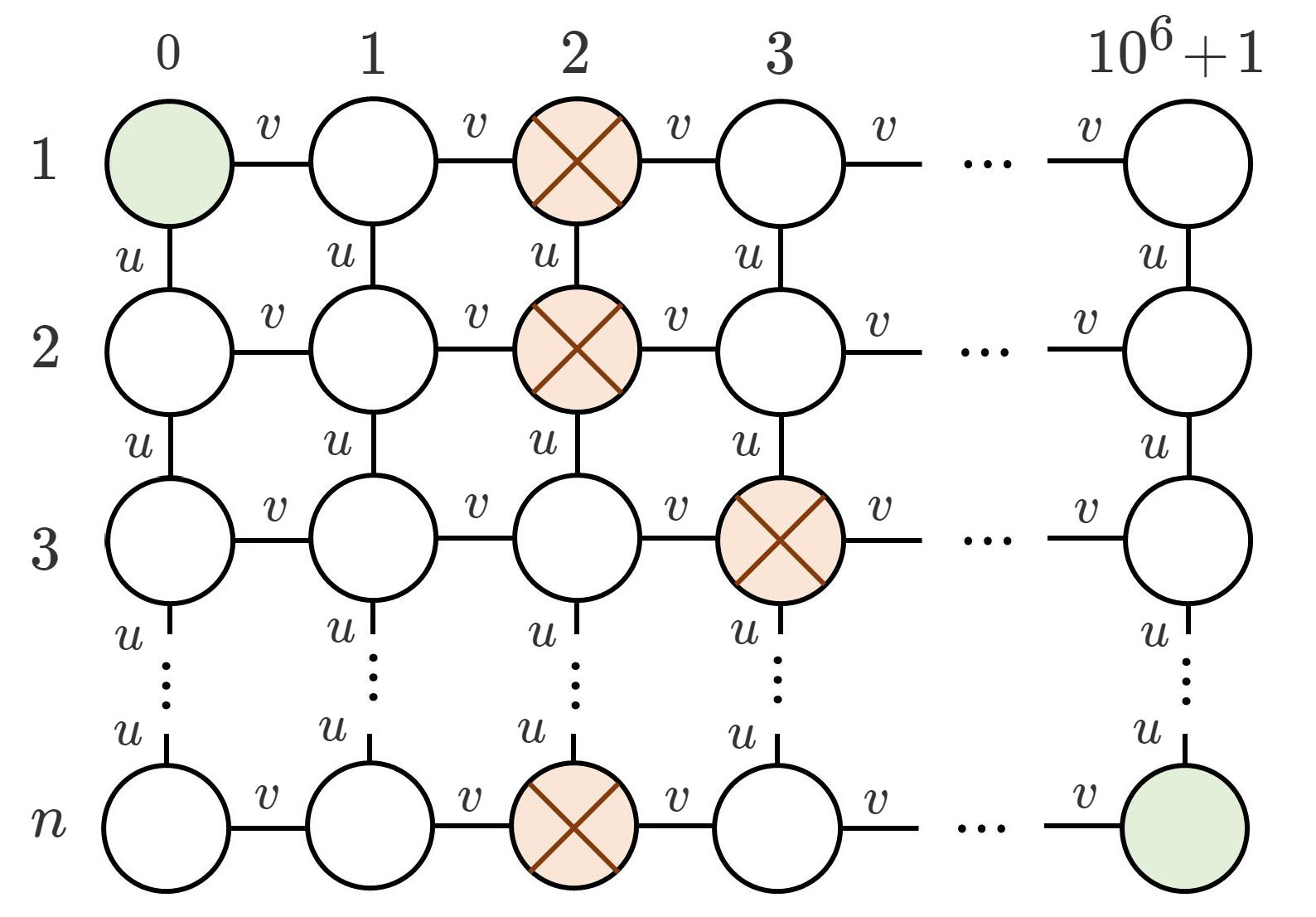
Let's denote the node in the row i and column j by (i,j).
Initially for each i the i-th row has exactly one obstacle — at node (i,ai). You want to move some obstacles so that you can reach node (n,106+1) from node (1,0) by moving through edges of this graph (you can't pass through obstacles). Moving one obstacle to an adjacent by edge free node costs u or v coins, as below:
- If there is an obstacle in the node (i,j), you can use u coins to move it to (i−1,j) or (i+1,j), if such node exists and if there is no obstacle in that node currently.
- If there is an obstacle in the node (i,j), you can use v coins to move it to (i,j−1) or (i,j+1), if such node exists and if there is no obstacle in that node currently.
- Note that you can't move obstacles outside the grid. For example, you can't move an obstacle from (1,1) to (0,1).
Refer to the picture above for a better understanding.
Now you need to calculate the minimal number of coins you need to spend to be able to reach node (n,106+1) from node (1,0) by moving through edges of this graph without passing through obstacles.
有一个 n 行、106+2 列的图,行编号为 1 至 n,列编号为 0 至 106+1:
我们用 (i,j) 表示第 i 行、第 j 列的节点。
初始时,对每个 i,第 i 行恰好有一个障碍物,位于节点 (i,ai)。你需要移动一些障碍物,使得能够从节点 (1,0) 出发,沿图的边到达节点 (n,106+1)(路径上不能经过任何障碍物)。将一个障碍物移动到一个相邻的、当前为空闲的节点所需花费为 u 或 v 枚金币,具体规则如下:
- 若节点 (i,j) 上存在障碍物,则可花费 u 枚金币将其移至 (i−1,j) 或 (i+1,j)(若该目标节点在图内且当前为空闲);
- 若节点 (i,j) 上存在障碍物,则可花费 v 枚金币将其移至 (i,j−1) 或 (i,j+1)(若该目标节点在图内且当前为空闲);
- 注意:障碍物不可移出网格边界。例如,不可将位于 (1,1) 的障碍物移至 (0,1)。
请参考上方图片以获得更直观的理解。
现在你需要计算:为使得能从节点 (1,0) 沿图的边到达节点 (n,106+1)(路径上不经过任何障碍物),所需花费的最少金币数。
输入格式
The first line contains a single integer t (1≤t≤104) — the number of test cases.
The first line of each test case contains three integers n, u and v (2≤n≤100, 1≤u,v≤109) — the number of rows in the graph and the numbers of coins needed to move vertically and horizontally respectively.
The second line of each test case contains n integers a1,a2,…,an (1≤ai≤106) — where ai represents that the obstacle in the i-th row is in node (i,ai).
It's guaranteed that the sum of n over all test cases doesn't exceed 2⋅104.
第一行包含一个整数 t(1≤t≤104)—— 表示测试用例的数量。
每个测试用例的第一行包含三个整数 n、u 和 v(2≤n≤100,1≤u,v≤109)—— 分别表示图中的行数,以及垂直移动和水平移动所需的金币数。
每个测试用例的第二行包含 n 个整数 a1,a2,…,an(1≤ai≤106)—— 其中 ai 表示第 i 行中的障碍物位于节点 (i,ai) 处。
保证所有测试用例的 n 之和不超过 2⋅104。
输出格式
For each test case, output a single integer — the minimal number of coins you need to spend to be able to reach node (n,106+1) from node (1,0) by moving through edges of this graph without passing through obstacles.
It can be shown that under the constraints of the problem there is always a way to make such a trip possible.
对于每个测试用例,输出一个整数——即:在不经过障碍物的前提下,通过图中的边从节点 (1,0) 到达节点 (n,106+1) 所需花费的最少硬币数。
可以证明,在本题的约束条件下,总存在一种方式使这样的行程成为可能。
输入输出样例
输入#1
3
2 3 4
2 2
2 3 4
3 2
2 4 3
3 2
输出#1
7
3
3
说明/提示
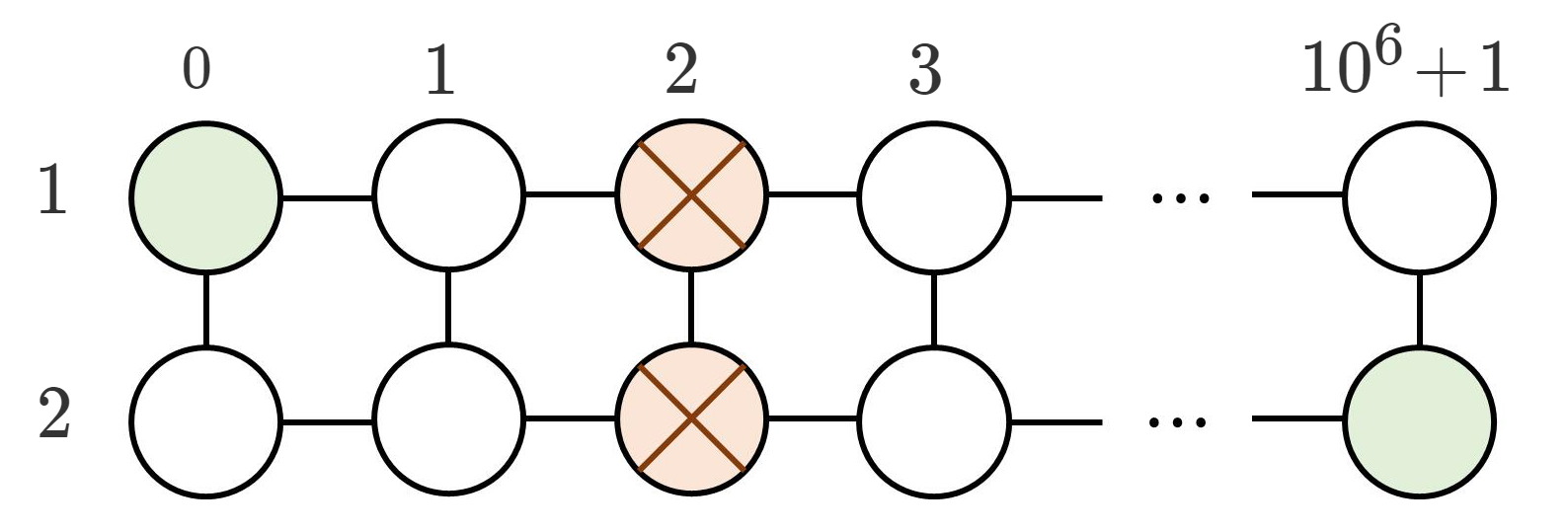
In the first sample, two obstacles are at (1,2) and (2,2). You can move the obstacle on (2,2) to (2,3), then to (1,3). The total cost is u+v=7 coins.
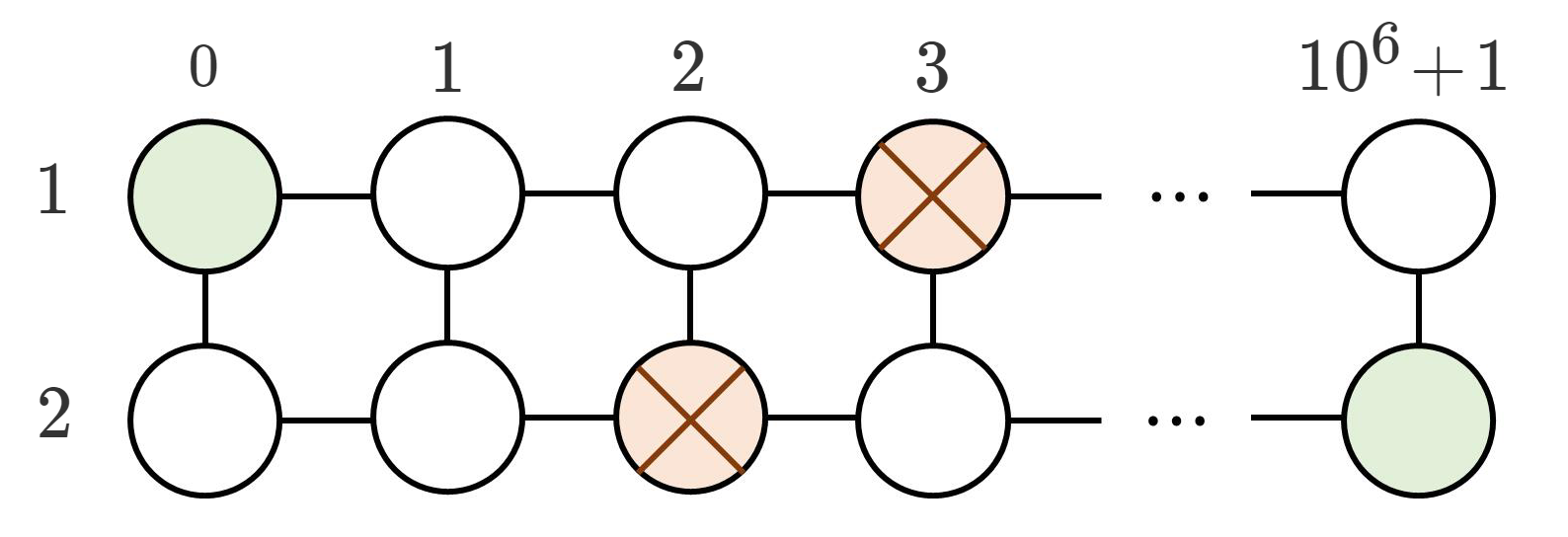
In the second sample, two obstacles are at (1,3) and (2,2). You can move the obstacle on (1,3) to (2,3). The cost is u=3 coins.
在第一个样例中,两个障碍物位于 (1,2) 和 (2,2)。你可以将位于 (2,2) 的障碍物先移动到 (2,3),再移动到 (1,3)。总花费为 u+v=7 枚金币。
在第二个样例中,两个障碍物位于 (1,3) 和 (2,2)。你可以将位于 (1,3) 的障碍物移动到 (2,3)。花费为 u=3 枚金币。
输入解题思路,AI测评打分。不知道怎么写?