

CF1462A.Favorite Sequence
入门
通过率:0%
时间限制:2.00s
内存限制:256MB


AC君温馨提醒
该题目为【codeforces】题库的题目,您提交的代码将被提交至codeforces进行远程评测,并由ACGO抓取测评结果后进行展示。由于远程测评的测评机由其他平台提供,我们无法保证该服务的稳定性,若提交后无反应,请等待一段时间后再进行重试。
题目描述
Polycarp has a favorite sequence a[1…n] consisting of n integers. He wrote it out on the whiteboard as follows:
- he wrote the number a1 to the left side (at the beginning of the whiteboard);
- he wrote the number a2 to the right side (at the end of the whiteboard);
- then as far to the left as possible (but to the right from a1), he wrote the number a3;
- then as far to the right as possible (but to the left from a2), he wrote the number a4;
- Polycarp continued to act as well, until he wrote out the entire sequence on the whiteboard.
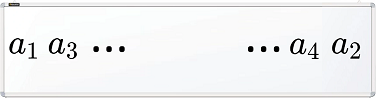 The beginning of the result looks like this (of course, if n≥4).
For example, if n=7 and a=[3,1,4,1,5,9,2], then Polycarp will write a sequence on the whiteboard [3,4,5,2,9,1,1].
You saw the sequence written on the whiteboard and now you want to restore Polycarp's favorite sequence.
Polycarp 有一个他最喜欢的序列 a[1…n],该序列由 n 个整数组成。他按如下方式将该序列写在黑板上:
- 他将数字 a1 写在左侧(即黑板开头);
- 他将数字 a2 写在右侧(即黑板末尾);
- 然后,他在尽可能靠左的位置(但必须在 a1 的右侧),写下数字 a3;
- 接着,他在尽可能靠右的位置(但必须在 a2 的左侧),写下数字 a4;
- Polycarp 持续以这种方式操作,直到整个序列全部写在黑板上。
结果的开头部分看起来像这样(当然,前提是 n≥4)。
例如,若 n=7 且 a=[3,1,4,1,5,9,2],则 Polycarp 在黑板上写出的序列为 [3,4,5,2,9,1,1]。
你看到了黑板上所写的序列,现在你想还原出 Polycarp 最喜欢的原始序列。
输入格式
The first line contains a single positive integer t (1≤t≤300) — the number of test cases in the test. Then t test cases follow.
The first line of each test case contains an integer n (1≤n≤300) — the length of the sequence written on the whiteboard.
The next line contains n integers b1,b2,…,bn (1≤bi≤109) — the sequence written on the whiteboard.
第一行包含一个正整数 t(1≤t≤300),表示测试用例的数量。随后是 t 个测试用例。
每个测试用例的第一行包含一个整数 n(1≤n≤300),表示写在白板上的序列的长度。
下一行包含 n 个整数 b1,b2,…,bn(1≤bi≤109),表示写在白板上的序列。
输出格式
Output t answers to the test cases. Each answer — is a sequence a that Polycarp wrote out on the whiteboard.
输出 t 个测试用例的答案。每个答案均为 Polycarp 写在白板上的序列 a。
输入输出样例
输入#1
6
7
3 4 5 2 9 1 1
4
9 2 7 1
11
8 4 3 1 2 7 8 7 9 4 2
1
42
2
11 7
8
1 1 1 1 1 1 1 1
输出#1
3 1 4 1 5 9 2
9 1 2 7
8 2 4 4 3 9 1 7 2 8 7
42
11 7
1 1 1 1 1 1 1 1
说明/提示
In the first test case, the sequence a matches the sequence from the statement. The whiteboard states after each step look like this:
[3]⇒[3,1]⇒[3,4,1]⇒[3,4,1,1]⇒[3,4,5,1,1]⇒[3,4,5,9,1,1]⇒[3,4,5,2,9,1,1].
在第一个测试用例中,序列 a 与题目描述中的序列一致。每一步操作后白板上的状态如下:
[3]⇒[3,1]⇒[3,4,1]⇒[3,4,1,1]⇒[3,4,5,1,1]⇒[3,4,5,9,1,1]⇒[3,4,5,2,9,1,1]。
输入解题思路,AI测评打分。不知道怎么写?