

CF1455E.Four Points
提高+/省选-
通过率:0%
时间限制:2.00s
内存限制:256MB


AC君温馨提醒
该题目为【codeforces】题库的题目,您提交的代码将被提交至codeforces进行远程评测,并由ACGO抓取测评结果后进行展示。由于远程测评的测评机由其他平台提供,我们无法保证该服务的稳定性,若提交后无反应,请等待一段时间后再进行重试。
题目描述
You are given four different integer points p1, p2, p3 and p4 on XY grid.
In one step you can choose one of the points pi and move it in one of four directions by one. In other words, if you have chosen point pi=(x,y) you can move it to (x,y+1), (x,y−1), (x+1,y) or (x−1,y).
Your goal to move points in such a way that they will form a square with sides parallel to OX and OY axes (a square with side 0 is allowed).
What is the minimum number of steps you need to make such a square?
给你 XY 平面上四个互不相同的整数点 p1、p2、p3 和 p4。
每一步中,你可以任选其中一个点 pi,并将其沿四个方向之一移动一个单位。换言之,若你选择了点 pi=(x,y),则可将其移动至 (x,y+1)、(x,y−1)、(x+1,y) 或 (x−1,y)。
你的目标是通过移动这些点,使它们构成一个边与 OX 轴和 OY 轴平行的正方形(允许边长为 0 的退化正方形)。
实现该目标所需的最少步数是多少?
输入格式
The first line contains a single integer t (1≤t≤104) — the number of test cases.
Each test case consists of four lines. Each line contains two integers x and y (0≤x,y≤109) — coordinates of one of the points pi=(x,y).
All points are different in one test case.
第一行包含一个整数 t(1≤t≤104)—— 测试用例的数量。
每个测试用例由四行组成。每行包含两个整数 x 和 y(0≤x,y≤109)—— 其中一个点 pi=(x,y) 的坐标。
在一个测试用例中,所有点互不相同。
输出格式
For each test case, print the single integer — the minimum number of steps to make a square.
对于每个测试用例,输出一个整数——使其成为正方形所需的最少步数。
输入输出样例
输入#1
3
0 2
4 2
2 0
2 4
1 0
2 0
4 0
6 0
1 6
2 2
2 5
4 1
输出#1
8
7
5
说明/提示
In the first test case, one of the optimal solutions is shown below:
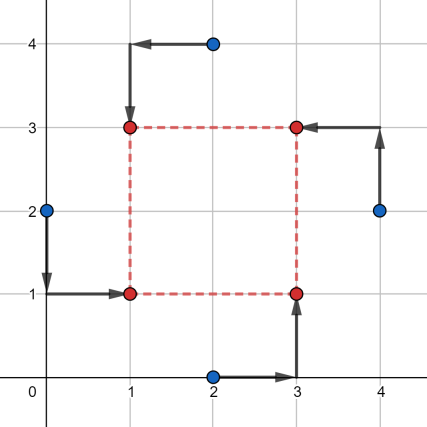
Each point was moved two times, so the answer 2+2+2+2=8.
In the second test case, one of the optimal solutions is shown below:
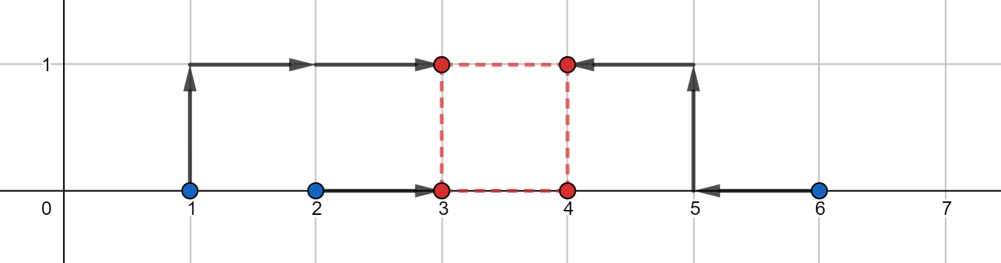
The answer is 3+1+0+3=7.
In the third test case, one of the optimal solutions is shown below:
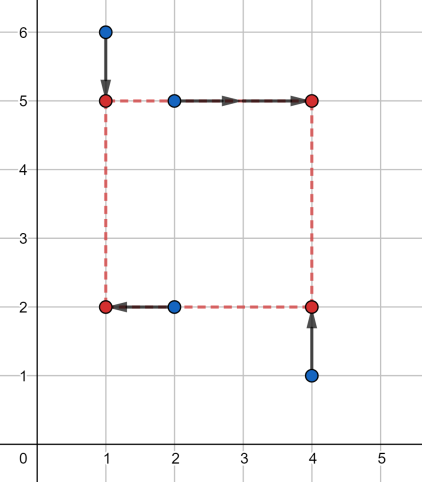
The answer is 1+1+2+1=5.
在第一个测试用例中,其中一个最优解如下所示:
每个点均被移动了两次,因此答案为 2+2+2+2=8。
在第二个测试用例中,其中一个最优解如下所示:
答案为 3+1+0+3=7。
在第三个测试用例中,其中一个最优解如下所示:
答案为 1+1+2+1=5。
输入解题思路,AI测评打分。不知道怎么写?