

CF1200F.Graph Traveler
提高+/省选-
通过率:0%
时间限制:2.00s
内存限制:512MB


AC君温馨提醒
该题目为【codeforces】题库的题目,您提交的代码将被提交至codeforces进行远程评测,并由ACGO抓取测评结果后进行展示。由于远程测评的测评机由其他平台提供,我们无法保证该服务的稳定性,若提交后无反应,请等待一段时间后再进行重试。
题目描述
Gildong is experimenting with an interesting machine Graph Traveler. In Graph Traveler, there is a directed graph consisting of n vertices numbered from 1 to n. The i-th vertex has mi outgoing edges that are labeled as ei[0], ei[1], …, ei[mi−1], each representing the destination vertex of the edge. The graph can have multiple edges and self-loops. The i-th vertex also has an integer ki written on itself.
A travel on this graph works as follows.
- Gildong chooses a vertex to start from, and an integer to start with. Set the variable c to this integer.
- After arriving at the vertex i, or when Gildong begins the travel at some vertex i, add ki to c.
- The next vertex is ei[x] where x is an integer 0≤x≤mi−1 satisfying x≡c(modmi). Go to the next vertex and go back to step 2.
It's obvious that a travel never ends, since the 2nd and the 3rd step will be repeated endlessly.
For example, assume that Gildong starts at vertex 1 with c=5, and m1=2, e1[0]=1, e1[1]=2, k1=−3. Right after he starts at vertex 1, c becomes 2. Since the only integer x (0≤x≤1) where x≡c(modmi) is 0, Gildong goes to vertex e1[0]=1. After arriving at vertex 1 again, c becomes −1. The only integer x satisfying the conditions is 1, so he goes to vertex e1[1]=2, and so on.
Since Gildong is quite inquisitive, he's going to ask you q queries. He wants to know how many distinct vertices will be visited infinitely many times, if he starts the travel from a certain vertex with a certain value of c. Note that you should not count the vertices that will be visited only finite times.
吉尔东正在试验一台有趣的机器——图旅行器(Graph Traveler)。在图旅行器中,存在一个由 n 个顶点构成的有向图,顶点编号从 1 到 n。第 i 个顶点有 mi 条出边,分别标记为 ei[0],ei[1],…,ei[mi−1],每条边指向其目标顶点。该图允许存在重边和自环。第 i 个顶点上还写有一个整数 ki。
在该图上的旅行过程如下:
- 吉尔东选择一个起始顶点和一个起始整数。将变量 c 设为该整数。
- 每当到达顶点 i(包括旅行初始时位于顶点 i),将 ki 加到 c 上。
- 下一个顶点为 ei[x],其中 x 是满足 0≤x≤mi−1 且 x≡c(modmi) 的整数。前往下一个顶点,并返回步骤 2。
显然,该旅行永远不会终止,因为步骤 2 和步骤 3 将无限重复。
例如,假设吉尔东从顶点 1 出发,初始 c=5,且 m1=2,e1[0]=1,e1[1]=2,k1=−3。他刚在顶点 1 开始旅行时,c 变为 2。由于在 0≤x≤1 范围内唯一满足 x≡c(modmi) 的整数是 x=0,吉尔东前往顶点 e1[0]=1。再次到达顶点 1 后,c 变为 −1。此时唯一满足条件的 x 是 1,因此他前往顶点 e1[1]=2,依此类推。
由于吉尔东十分好奇,他将向你提出 q 个询问。他想知道:若从某个特定顶点出发、并以某个特定的 c 值开始旅行,则最终会被无限次访问的不同顶点的个数是多少?注意:你不应计入那些仅被有限次访问的顶点。
输入格式
The first line of the input contains an integer n (1≤n≤1000), the number of vertices in the graph.
The second line contains n integers. The i-th integer is ki (−109≤ki≤109), the integer written on the i-th vertex.
Next 2⋅n lines describe the edges of each vertex. The (2⋅i+1)-st line contains an integer mi (1≤mi≤10), the number of outgoing edges of the i-th vertex. The (2⋅i+2)-nd line contains mi integers ei[0], ei[1], …, ei[mi−1], each having an integer value between 1 and n, inclusive.
Next line contains an integer q (1≤q≤105), the number of queries Gildong wants to ask.
Next q lines contains two integers x and y (1≤x≤n, −109≤y≤109) each, which mean that the start vertex is x and the starting value of c is y.
输入的第一行包含一个整数 n(1≤n≤1000),表示图中顶点的数量。
第二行包含 n 个整数。其中第 i 个整数为 ki(−109≤ki≤109),表示写在第 i 个顶点上的整数。
接下来的 2⋅n 行描述每个顶点的边。第 (2⋅i+1) 行包含一个整数 mi(1≤mi≤10),表示第 i 个顶点的出边数量;第 (2⋅i+2) 行包含 mi 个整数 ei[0],ei[1],…,ei[mi−1],每个值均在 1 到 n(含)之间。
下一行包含一个整数 q(1≤q≤105),表示 Gildong 想要提出的查询次数。
接下来的 q 行每行包含两个整数 x 和 y(1≤x≤n,−109≤y≤109),表示起始顶点为 x,且变量 c 的初始值为 y。
输出格式
For each query, print the number of distinct vertices that will be visited infinitely many times, if Gildong starts at vertex x with starting integer y.
对于每个查询,请输出:如果吉隆从顶点 x 出发,且初始整数为 y,则会被无限次访问的不同顶点的数量。
输入输出样例
输入#1
4
0 0 0 0
2
2 3
1
2
3
2 4 1
4
3 1 2 1
6
1 0
2 0
3 -1
4 -2
1 1
1 5
输出#1
1
1
2
1
3
2
输入#2
4
4 -5 -3 -1
2
2 3
1
2
3
2 4 1
4
3 1 2 1
6
1 0
2 0
3 -1
4 -2
1 1
1 5
输出#2
1
1
1
3
1
1
说明/提示
The first example can be shown like the following image:
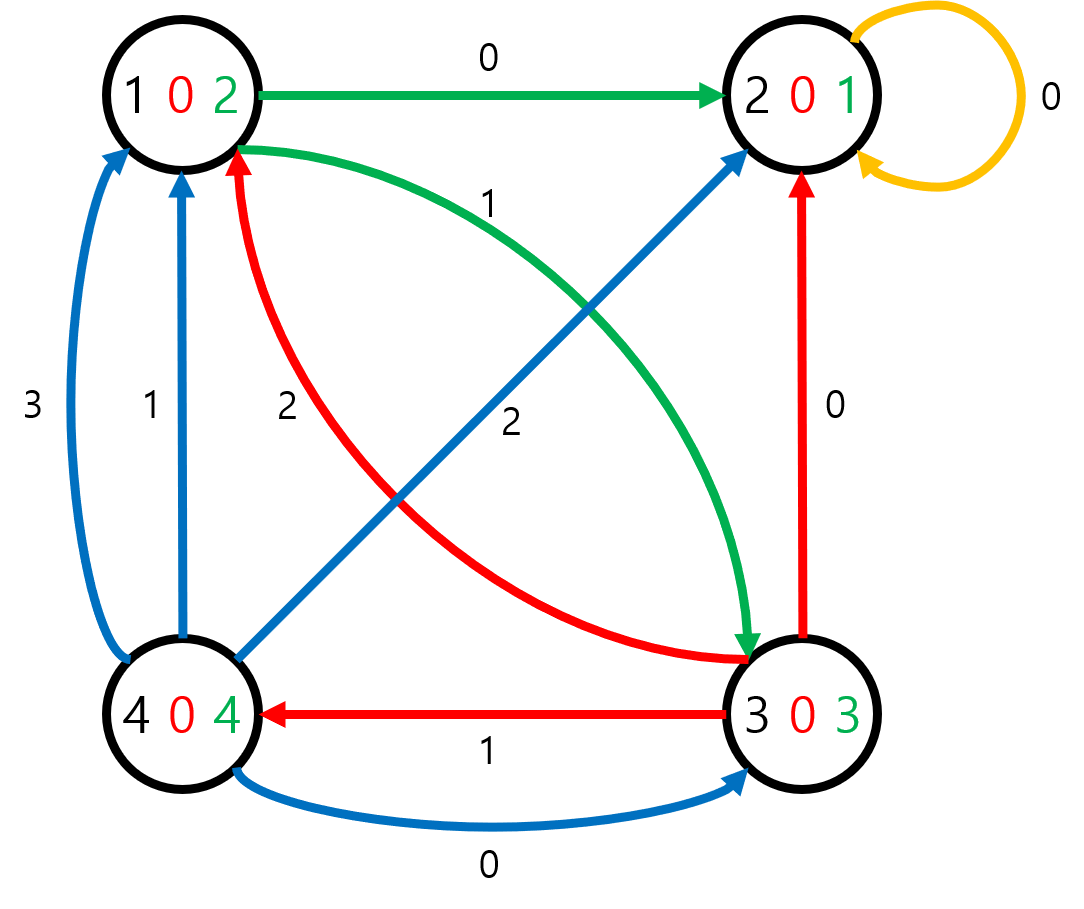
Three integers are marked on i-th vertex: i, ki, and mi respectively. The outgoing edges are labeled with an integer representing the edge number of i-th vertex.
The travel for each query works as follows. It is described as a sequence of phrases, each in the format "vertex (c after ki added)".
- 1(0)→2(0)→2(0)→…
- 2(0)→2(0)→…
- 3(−1)→1(−1)→3(−1)→…
- 4(−2)→2(−2)→2(−2)→…
- 1(1)→3(1)→4(1)→1(1)→…
- 1(5)→3(5)→1(5)→…
The second example is same as the first example, except that the vertices have non-zero values. Therefore the answers to the queries also differ from the first example.
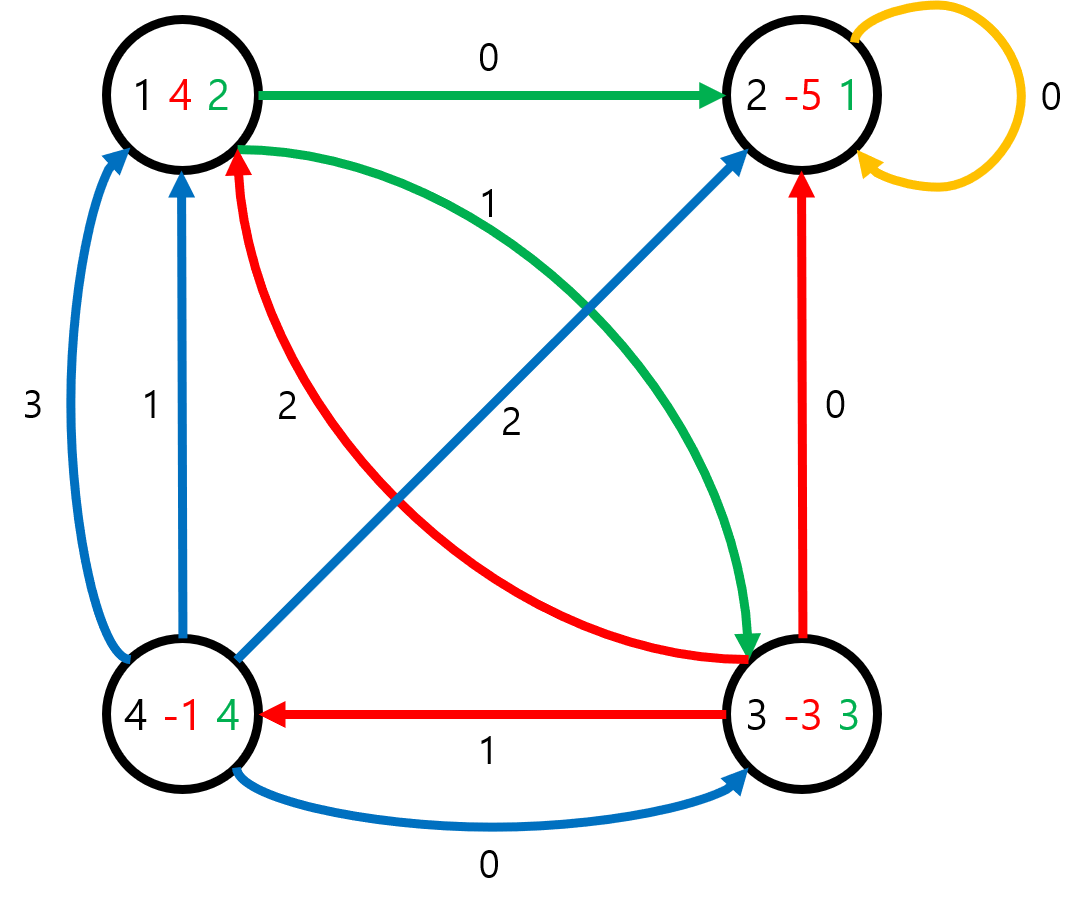
The queries for the second example works as follows:
- 1(4)→2(−1)→2(−6)→…
- 2(−5)→2(−10)→…
- 3(−4)→1(0)→2(−5)→2(−10)→…
- 4(−3)→1(1)→3(−2)→4(−3)→…
- 1(5)→3(2)→1(6)→2(1)→2(−4)→…
- 1(9)→3(6)→2(1)→2(−4)→…
第一个示例可如下图所示:
第 i 个顶点上标记有三个整数:i、ki 和 mi。从该顶点出发的边用整数标注,表示该顶点的第几条出边。
每次查询的遍历过程如下所述,其形式为一系列短语,每个短语格式为“顶点(在加上 ki 后的 c 值)”。
- 1(0)→2(0)→2(0)→…
- 2(0)→2(0)→…
- 3(−1)→1(−1)→3(−1)→…
- 4(−2)→2(−2)→2(−2)→…
- 1(1)→3(1)→4(1)→1(1)→…
- 1(5)→3(5)→1(5)→…
第二个示例与第一个示例相同,仅顶点上的值非零。因此,各查询的答案也与第一个示例不同。
第二个示例的查询过程如下:
- 1(4)→2(−1)→2(−6)→…
- 2(−5)→2(−10)→…
- 3(−4)→1(0)→2(−5)→2(−10)→…
- 4(−3)→1(1)→3(−2)→4(−3)→…
- 1(5)→3(2)→1(6)→2(1)→2(−4)→…
- 1(9)→3(6)→2(1)→2(−4)→…
输入解题思路,AI测评打分。不知道怎么写?