

CF1137C.Museums Tour
省选/NOI-
通过率:0%
时间限制:4.00s
内存限制:512MB


AC君温馨提醒
该题目为【codeforces】题库的题目,您提交的代码将被提交至codeforces进行远程评测,并由ACGO抓取测评结果后进行展示。由于远程测评的测评机由其他平台提供,我们无法保证该服务的稳定性,若提交后无反应,请等待一段时间后再进行重试。
题目描述
In the country N, there are n cities connected by m one-way roads. Although this country seems unremarkable, there are two interesting facts about it. At first, a week lasts d days here. At second, there is exactly one museum in each city of the country N.
Travel agency "Open museums" is developing a new program for tourists interested in museums. Agency's employees know which days each of the museums is open. The tour should start in the capital — the city number 1, and the first day of the tour must be on the first day of a week. Each day a tourist will be in some city, watching the exposition in its museum (in case museum is open today), and by the end of the day, the tour either ends or the tourist goes into another city connected by a road with the current one. The road system of N is designed in such a way that traveling by a road always takes one night and also all the roads are one-way. It's allowed to visit a city multiple times during the trip.
You should develop such route for the trip that the number of distinct museums, possible to visit during it, is maximum.
在国家 N 中,有 n 座城市,由 m 条单向道路连接。尽管这个国家看似平凡,但它却有两个有趣的事实:第一,这里的一周持续 d 天;第二,国家 N 的每座城市中恰好有一座博物馆。
旅行社“开放博物馆”正在为对博物馆感兴趣的游客开发一项新旅游项目。该旅行社的员工已知每座博物馆在一周中的哪些天开放。旅行必须从首都——即编号为 1 的城市——出发,且旅行的第一天必须是一周的第一天。每天,游客将身处某座城市,并参观该市博物馆的展览(前提是该博物馆当天开放);到当天结束时,旅行要么终止,要么游客经由一条与当前城市相连的道路前往另一座城市。国家 N 的道路系统设计使得沿任意道路通行总需耗费一个夜晚,且所有道路均为单向。在旅行过程中,允许重复访问同一座城市。
你需要规划一条旅行路线,使得在该路线中能够参观到的不同博物馆的数量最大化。
输入格式
The first line contains three integers n, m and d (1≤n≤100000, 0≤m≤100000, 1≤d≤50), the number of cities, the number of roads and the number of days in a week.
Each of next m lines contains two integers ui and vi (1≤ui,vi≤n, ui=vi), denoting a one-way road from the city ui to the city vi.
The next n lines contain the museums' schedule. The schedule of the museum located in the i-th city is described in the i-th of these lines. Each line consists of exactly d characters "0" or "1", the j-th character of the string equals to "1" if the museum is open at the j-th day of a week, and "0", otherwise.
It's guaranteed that for each pair of cities (u,v) there exists no more than one road leading from u to v.
第一行包含三个整数 n、m 和 d(1≤n≤100000,0≤m≤100000,1≤d≤50),分别表示城市的数量、道路的数量以及一周的天数。
接下来的 m 行,每行包含两个整数 ui 和 vi(1≤ui,vi≤n,ui=vi),表示一条从城市 ui 到城市 vi 的单向道路。
接下来的 n 行描述各博物馆的开放时间表。其中第 i 行描述位于第 i 个城市的博物馆的时间表。每行恰好包含 d 个字符,每个字符为 "0" 或 "1";该字符串的第 j 个字符为 "1" 表示该博物馆在每周的第 j 天开放,为 "0" 表示不开放。
保证对于任意一对城市 (u,v),至多只存在一条从 u 到 v 的道路。
输出格式
Print a single integer — the maximum number of distinct museums, that it's possible to visit, starting a trip in the first city on the first day of the week.
输出一个整数——从第一座城市、一周的第一天开始旅行,最多可以参观的不同博物馆的数量。
输入输出样例
输入#1
4 5 3
3 1
1 2
2 4
4 1
2 3
011
110
111
001
输出#1
3
输入#2
3 3 7
1 2
1 3
2 3
1111111
0000000
0111111
输出#2
2
说明/提示
Explanation of the first example 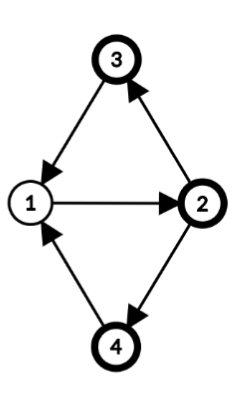
The maximum number of distinct museums to visit is 3. It's possible to visit 3 museums, for example, in the way described below.
- Day 1. Now it's the 1st day of a week, and the tourist is in the city 1. The museum there is closed. At night the tourist goes to the city number 2.
- Day 2. Now it's the 2nd day of a week, and the tourist is in the city 2. The museum there is open, and the tourist visits it. At night the tourist goes to the city number 4.
- Day 3. Now it's the 3rd day of a week, and the tourist is in the city 4. The museum there is open, and the tourist visits it. At night the tourist goes to the city number 1.
- Day 4. Now it's the 1st day of a week, and the tourist is in the city 1. The museum there is closed. At night the tourist goes to the city number 2.
- Day 5. Now it's the 2nd of a week number 2, and the tourist is in the city 2. The museum there is open, but the tourist has already visited it. At night the tourist goes to the city number 3.
- Day 6. Now it's the 3rd day of a week, and the tourist is in the city 3. The museum there is open, and the tourist visits it. After this, the tour is over.
Explanation of the second example 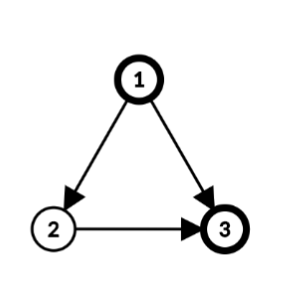
The maximum number of distinct museums to visit is 2. It's possible to visit 2 museums, for example, in the way described below.
- Day 1. Now it's the 1st day of a week, and the tourist is in the city 1. The museum there is open, and the tourist visits it. At night the tourist goes to the city number 2.
- Day 2. Now it's the 2nd day of a week, and the tourist is in the city 2. The museum there is closed. At night the tourist goes to the city number 3.
- Day 3. Now it's the 3rd day of a week, and the tourist is in the city 3. The museum there is open, and the tourist visits it. After this, the tour is over.
最多可参观的不同博物馆数量为 3。例如,可通过如下方式参观 3 个博物馆:
- 第 1 天:当前是一周中的第 1 天,游客位于城市 1。该城市的博物馆关闭。夜间,游客前往城市 2。
- 第 2 天:当前是一周中的第 2 天,游客位于城市 2。该城市的博物馆开放,游客参观该博物馆。夜间,游客前往城市 4。
- 第 3 天:当前是一周中的第 3 天,游客位于城市 4。该城市的博物馆开放,游客参观该博物馆。夜间,游客前往城市 1。
- 第 4 天:当前是一周中的第 1 天,游客位于城市 1。该城市的博物馆关闭。夜间,游客前往城市 2。
- 第 5 天:当前是第 2 周的第 2 天,游客位于城市 2。该城市的博物馆开放,但游客此前已参观过。夜间,游客前往城市 3。
- 第 6 天:当前是一周中的第 3 天,游客位于城市 3。该城市的博物馆开放,游客参观该博物馆。此后,旅行结束。
最多可参观的不同博物馆数量为 2。例如,可通过如下方式参观 2 个博物馆:
- 第 1 天:当前是一周中的第 1 天,游客位于城市 1。该城市的博物馆开放,游客参观该博物馆。夜间,游客前往城市 2。
- 第 2 天:当前是一周中的第 2 天,游客位于城市 2。该城市的博物馆关闭。夜间,游客前往城市 3。
- 第 3 天:当前是一周中的第 3 天,游客位于城市 3。该城市的博物馆开放,游客参观该博物馆。此后,旅行结束。
输入解题思路,AI测评打分。不知道怎么写?