

CF1097H.Mateusz and an Infinite Sequence
NOI/NOI+/CTSC
通过率:0%
时间限制:7.00s
内存限制:512MB


AC君温馨提醒
该题目为【codeforces】题库的题目,您提交的代码将被提交至codeforces进行远程评测,并由ACGO抓取测评结果后进行展示。由于远程测评的测评机由其他平台提供,我们无法保证该服务的稳定性,若提交后无反应,请等待一段时间后再进行重试。
题目描述
A Thue-Morse-Radecki-Mateusz sequence (Thorse-Radewoosh sequence in short) is an infinite sequence constructed from a finite sequence gen of length d and an integer m, obtained in the following sequence of steps:
- In the beginning, we define the one-element sequence M0=(0).
- In the k-th step, k≥1, we define the sequence Mk to be the concatenation of the d copies of Mk−1. However, each of them is altered slightly — in the i-th of them (1≤i≤d), each element x is changed to (x+geni)(modm).
For instance, if we pick gen=(0,1,2) and m=4:
- M0=(0),
- M1=(0,1,2),
- M2=(0,1,2,1,2,3,2,3,0),
- M3=(0,1,2,1,2,3,2,3,0,1,2,3,2,3,0,3,0,1,2,3,0,3,0,1,0,1,2), and so on.
As you can see, as long as the first element of gen is 0, each consecutive step produces a sequence whose prefix is the sequence generated in the previous step. Therefore, we can define the infinite Thorse-Radewoosh sequence M∞ as the sequence obtained by applying the step above indefinitely. For the parameters above, M∞=(0,1,2,1,2,3,2,3,0,1,2,3,2,3,0,3,0,1,…).
Mateusz picked a sequence gen and an integer m, and used them to obtain a Thorse-Radewoosh sequence M∞. He then picked two integers l, r, and wrote down a subsequence of this sequence A:=((M∞)l,(M∞)l+1,…,(M∞)r).
Note that we use the 1-based indexing both for M∞ and A.
Mateusz has his favorite sequence B with length n, and would like to see how large it is compared to A. Let's say that B majorizes sequence X of length n (let's denote it as B≥X) if and only if for all i∈1,2,…,n, we have Bi≥Xi.
He now asks himself how many integers x in the range [1,∣A∣−n+1] there are such that B≥(Ax,Ax+1,Ax+2,…,Ax+n−1). As both sequences were huge, answering the question using only his pen and paper turned out to be too time-consuming. Can you help him automate his research?
托尔-摩尔斯-拉德茨基-马泰乌什序列(简称“托尔-拉德沃什序列”)是一种由长度为 d 的有限序列 gen 和整数 m 构造出的无限序列,其构造步骤如下:
- 初始时,定义单元素序列 M0=(0);
- 在第 k 步(k≥1),将序列 Mk 定义为 d 个 Mk−1 的拼接。但每个副本均作轻微修改:在第 i 个副本中(1≤i≤d),其中每个元素 x 均被替换为 (x+geni)modm。
例如,若取 gen=(0,1,2) 且 m=4,则有:
- M0=(0),
- M1=(0,1,2),
- M2=(0,1,2,1,2,3,2,3,0),
- M3=(0,1,2,1,2,3,2,3,0,1,2,3,2,3,0,3,0,1,2,3,0,3,0,1,0,1,2),依此类推。
如你所见,只要 gen 的首元素为 0,则每一步生成的新序列都以此前一步生成的序列为前缀。因此,我们可以将无限托尔-拉德沃什序列 M∞ 定义为上述过程无限进行后所得的序列。对上述参数,有
M∞=(0,1,2,1,2,3,2,3,0,1,2,3,2,3,0,3,0,1,…)。
马泰乌什选取了一个序列 gen 和一个整数 m,并据此生成了托尔-拉德沃什序列 M∞。随后他选取两个整数 l、r,并写下该序列的一个子序列
A:=((M∞)l, (M∞)l+1, …, (M∞)r)。
注意:此处 M∞ 和 A 均采用从 1 开始的下标。
马泰乌什有一个他钟爱的长度为 n 的序列 B,他希望比较 B 与 A 的大小关系。我们称:当且仅当对所有 i∈{1,2,…,n} 均有 Bi≥Xi 时,序列 B 控制(majorizes) 长度为 n 的序列 X(记作 B≥X)。
现在他想知道自己有多少个整数 x 满足 x∈[1, ∣A∣−n+1],使得
B≥(Ax, Ax+1, Ax+2, …, Ax+n−1)。
由于两个序列规模极大,仅靠纸笔计算这一问题耗时过长。你能帮他将这项研究自动化吗?
输入格式
The first line contains two integers d and m (2≤d≤20, 2≤m≤60) — the length of the sequence gen and an integer used to perform the modular operations. The second line contains d integers geni (0≤geni<m). It's guaranteed that the first element of the sequence gen is equal to zero.
The third line contains one integer n (1≤n≤30000) — the length of the sequence B. The fourth line contains n integers Bi (0≤Bi<m). The fifth line contains two integers l and r (1≤l≤r≤1018, r−l+1≥n).
第一行包含两个整数 d 和 m(2≤d≤20,2≤m≤60)—— 分别表示序列 gen 的长度以及用于执行模运算的整数。
第二行包含 d 个整数 geni(0≤geni<m)。保证序列 gen 的第一个元素为零。
第三行包含一个整数 n(1≤n≤30000)—— 表示序列 B 的长度。
第四行包含 n 个整数 Bi(0≤Bi<m)。
第五行包含两个整数 l 和 r(1≤l≤r≤1018,且 r−l+1≥n)。
输出格式
Print a single integer — the answer to the problem.
输出一个整数——该问题的答案。
输入输出样例
输入#1
2 2
0 1
4
0 1 1 0
2 21
输出#1
6
输入#2
3 4
0 1 2
2
0 2
6 11
输出#2
1
说明/提示
Thorse-Radewoosh sequence in the first example is the standard Thue-Morse sequence, so the sequence A is as follows: 11010011001011010010. Here are the places where the sequence B majorizes A:
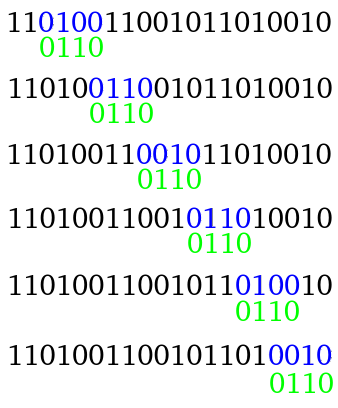
第一个例子中的 Thorse-Radewoosh 序列即为标准的 Thue-Morse 序列,因此序列 A 如下:11010011001011010010。以下是序列 B 主导(majorizes)序列 A 的位置:
输入解题思路,AI测评打分。不知道怎么写?