

CF989C.A Mist of Florescence
普及+/提高
通过率:0%
时间限制:1.00s
内存限制:256MB


AC君温馨提醒
该题目为【codeforces】题库的题目,您提交的代码将被提交至codeforces进行远程评测,并由ACGO抓取测评结果后进行展示。由于远程测评的测评机由其他平台提供,我们无法保证该服务的稳定性,若提交后无反应,请等待一段时间后再进行重试。
题目描述
As the boat drifts down the river, a wood full of blossoms shows up on the riverfront.
"I've been here once," Mino exclaims with delight, "it's breathtakingly amazing."
"What is it like?"
"Look, Kanno, you've got your paintbrush, and I've got my words. Have a try, shall we?"
There are four kinds of flowers in the wood, Amaranths, Begonias, Centaureas and Dianthuses.
The wood can be represented by a rectangular grid of n rows and m columns. In each cell of the grid, there is exactly one type of flowers.
According to Mino, the numbers of connected components formed by each kind of flowers are a, b, c and d respectively. Two cells are considered in the same connected component if and only if a path exists between them that moves between cells sharing common edges and passes only through cells containing the same flowers.
You are to help Kanno depict such a grid of flowers, with n and m arbitrarily chosen under the constraints given below. It can be shown that at least one solution exists under the constraints of this problem.
Note that you can choose arbitrary n and m under the constraints below, they are not given in the input.
当小船顺流而下时,河岸上出现了一片繁花盛开的树林。
“我以前来过这里!”美浓欣喜地喊道,“简直美得令人窒息!”
“它是什么样子的?”
“看,Kanno,你有画笔,而我有文字。我们来试试吧,怎么样?”
树林中有四种花:苋菜(Amaranths)、秋海棠(Begonias)、矢车菊(Centaureas)和石竹(Dianthuses)。
这片树林可用一个 n 行 m 列的矩形网格表示。网格中每个格子恰好种植一种花。
据美浓所述,这四种花各自所形成的连通块数量分别为 a、b、c 和 d。两个格子属于同一连通块,当且仅当存在一条路径连接它们,该路径仅沿公共边在相邻格子间移动,且路径上所有格子均种植同一种花。
你需要帮助 Kanno 构造出这样一张花的网格图;其中 n 和 m 可任选,只需满足下述约束条件即可。可以证明,在本题给定的约束条件下,至少存在一个解。
注意:你可在下方约束范围内任意选择 n 和 m,它们并非输入数据。
输入格式
The first and only line of input contains four space-separated integers a, b, c and d (1≤a,b,c,d≤100) — the required number of connected components of Amaranths, Begonias, Centaureas and Dianthuses, respectively.
输入仅有一行,包含四个以空格分隔的整数 a、b、c 和 d(1≤a,b,c,d≤100),分别表示所需的千日红(Amaranths)、秋海棠(Begonias)、蓝刺头(Centaureas)和石竹(Dianthuses)的连通块数量。
输出格式
In the first line, output two space-separated integers n and m (1≤n,m≤50) — the number of rows and the number of columns in the grid respectively.
Then output n lines each consisting of m consecutive English letters, representing one row of the grid. Each letter should be among 'A', 'B', 'C' and 'D', representing Amaranths, Begonias, Centaureas and Dianthuses, respectively.
In case there are multiple solutions, print any. You can output each letter in either case (upper or lower).
第一行输出两个用空格分隔的整数 n 和 m(1≤n,m≤50),分别表示网格的行数和列数。
随后输出 n 行,每行包含 m 个连续的英文字母,代表网格的一行。每个字母必须是 'A'、'B'、'C' 或 'D' 之一,分别代表千日红(Amaranths)、秋海棠(Begonias)、蓝刺头(Centaureas)和石竹(Dianthuses)。
若存在多个解,输出任意一个即可。每个字母可使用大写或小写形式。
输入输出样例
输入#1
5 3 2 1
输出#1
4 7
DDDDDDD
DABACAD
DBABACD
DDDDDDD
输入#2
50 50 1 1
输出#2
4 50
CCCCCCCCCCCCCCCCCCCCCCCCCCCCCCCCCCCCCCCCCCCCCCCCCC
ABABABABABABABABABABABABABABABABABABABABABABABABAB
BABABABABABABABABABABABABABABABABABABABABABABABABA
DDDDDDDDDDDDDDDDDDDDDDDDDDDDDDDDDDDDDDDDDDDDDDDDDD
输入#3
1 6 4 5
输出#3
7 7
DDDDDDD
DDDBDBD
DDCDCDD
DBDADBD
DDCDCDD
DBDBDDD
DDDDDDD
说明/提示
In the first example, each cell of Amaranths, Begonias and Centaureas forms a connected component, while all the Dianthuses form one.
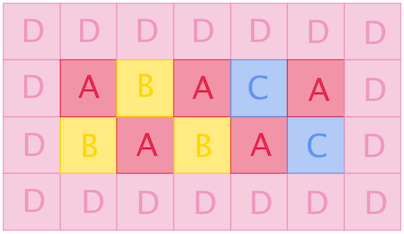
在第一个例子中,每个苋属(Amaranths)、秋海棠属(Begonias)和蓝刺头属(Centaureas)的格子各自构成一个连通分量,而所有石竹属(Dianthuses)则共同构成一个连通分量。
输入解题思路,AI测评打分。不知道怎么写?