

CF771C.Bear and Tree Jumps
提高+/省选-
通过率:0%
时间限制:2.00s
内存限制:256MB


AC君温馨提醒
该题目为【codeforces】题库的题目,您提交的代码将被提交至codeforces进行远程评测,并由ACGO抓取测评结果后进行展示。由于远程测评的测评机由其他平台提供,我们无法保证该服务的稳定性,若提交后无反应,请等待一段时间后再进行重试。
题目描述
A tree is an undirected connected graph without cycles. The distance between two vertices is the number of edges in a simple path between them.
Limak is a little polar bear. He lives in a tree that consists of n vertices, numbered 1 through n.
Limak recently learned how to jump. He can jump from a vertex to any vertex within distance at most k.
For a pair of vertices (s, t) we define f(s, t) as the minimum number of jumps Limak needs to get from s to t. Your task is to find the sum of f(s, t) over all pairs of vertices (s, t) such that s < t.
树是一类无向连通图,且不含环。两个顶点之间的距离定义为它们之间简单路径上的边数。
Limak 是一只小北极熊。他生活在一棵包含 n 个顶点的树上,顶点编号为 1 到 n。
最近,Limak 学会了跳跃。他可以从一个顶点跳到任意一个与其距离不超过 k 的顶点。
对于一对顶点 (s,t),我们定义 f(s,t) 为 Limak 从 s 到 t 所需的最少跳跃次数。你的任务是计算所有满足 s<t 的顶点对 (s,t) 对应的 f(s,t) 之和。
输入格式
The first line of the input contains two integers n and k (2 ≤ n ≤ 200 000, 1 ≤ k ≤ 5) — the number of vertices in the tree and the maximum allowed jump distance respectively.
The next n - 1 lines describe edges in the tree. The i-th of those lines contains two integers a__i and b__i (1 ≤ a__i, b__i ≤ n) — the indices on vertices connected with i-th edge.
It's guaranteed that the given edges form a tree.
输入的第一行包含两个整数 n 和 k(2≤n≤200000,1≤k≤5)—— 分别表示树中顶点的数量和允许的最大跳跃距离。
接下来的 n−1 行描述树中的边。其中第 i 行包含两个整数 ai 和 bi(1≤ai,bi≤n)—— 表示第 i 条边所连接的两个顶点的编号。
保证所给的边构成一棵树。
输出格式
Print one integer, denoting the sum of f(s, t) over all pairs of vertices (s, t) such that s < t.
输出一个整数,表示对所有满足 s<t 的顶点对 (s,t) 的 f(s,t) 之和。
输入输出样例
输入#1
6 2
1 2
1 3
2 4
2 5
4 6
输出#1
20
输入#2
13 3
1 2
3 2
4 2
5 2
3 6
10 6
6 7
6 13
5 8
5 9
9 11
11 12
输出#2
114
输入#3
3 5
2 1
3 1
输出#3
3
说明/提示
In the first sample, the given tree has 6 vertices and it's displayed on the drawing below. Limak can jump to any vertex within distance at most 2. For example, from the vertex 5 he can jump to any of vertices: 1, 2 and 4 (well, he can also jump to the vertex 5 itself).
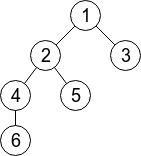
There are  pairs of vertices (s, t) such that s < t. For 5 of those pairs Limak would need two jumps: (1, 6), (3, 4), (3, 5), (3, 6), (5, 6). For other 10 pairs one jump is enough. So, the answer is 5·2 + 10·1 = 20.
In the third sample, Limak can jump between every two vertices directly. There are 3 pairs of vertices (s < t), so the answer is 3·1 = 3.
在第一个样例中,给定的树有 6 个顶点,如下图所示。Limak 可以跳跃至距离不超过 2 的任意顶点。例如,从顶点 5 出发,他可以跳到顶点 1、2 和 4(当然,他也可以跳到顶点 5 自身)。
共有 对顶点 $ (s,,t) $ 满足 $ s < t 。其中,有5对顶点需要恰好两次跳跃才能到达: (1,,6),,(3,,4),,(3,,5),,(3,,6),,(5,,6) $;其余 10 对顶点只需一次跳跃即可。因此,答案为 $ 5 \cdot 2 + 10 \cdot 1 = 20 $。
在第三个样例中,Limak 可以直接在任意两个顶点之间跳跃。共有 3 对顶点满足 $ s < t $,因此答案为 $ 3 \cdot 1 = 3 $。
输入解题思路,AI测评打分。不知道怎么写?