

CF2192D.Cost of Tree
普及+/提高
通过率:0%
时间限制:3.00s
内存限制:256MB


AC君温馨提醒
该题目为【codeforces】题库的题目,您提交的代码将被提交至codeforces进行远程评测,并由ACGO抓取测评结果后进行展示。由于远程测评的测评机由其他平台提供,我们无法保证该服务的稳定性,若提交后无反应,请等待一段时间后再进行重试。
题目描述
For a tree T with root r, where each node u has a value au associated with it, the cost of the tree defined as:
sum_uinT(a_ucdotd(r,u))
Here, this sum is taken over all nodes u in the tree T, and d(r,u) denotes the number of edges on the shortest path from node r to node u on a tree.
You are given a tree consisting of n nodes, rooted at node 1. Each node i has a value ai assigned to it. For each r from 1 to n, please solve the following problem independently:
Consider the subtree of node r with respect to node 1. Formally, the subtree of node r is the tree consisting of all nodes u such that the shortest path from 1 to u contains r.
Find the maximum cost of the subtree after performing at most one operation of the following type on the subtree:
- Choose any node u (u=r). Remove the edge from u to the parent of node u∗. Then, add an edge from u to any node v that is still reachable from r. It can be shown that after this operation, the graph remains a tree.
As an example, below shows an example of an operation with r=1,u=5, and v=4.
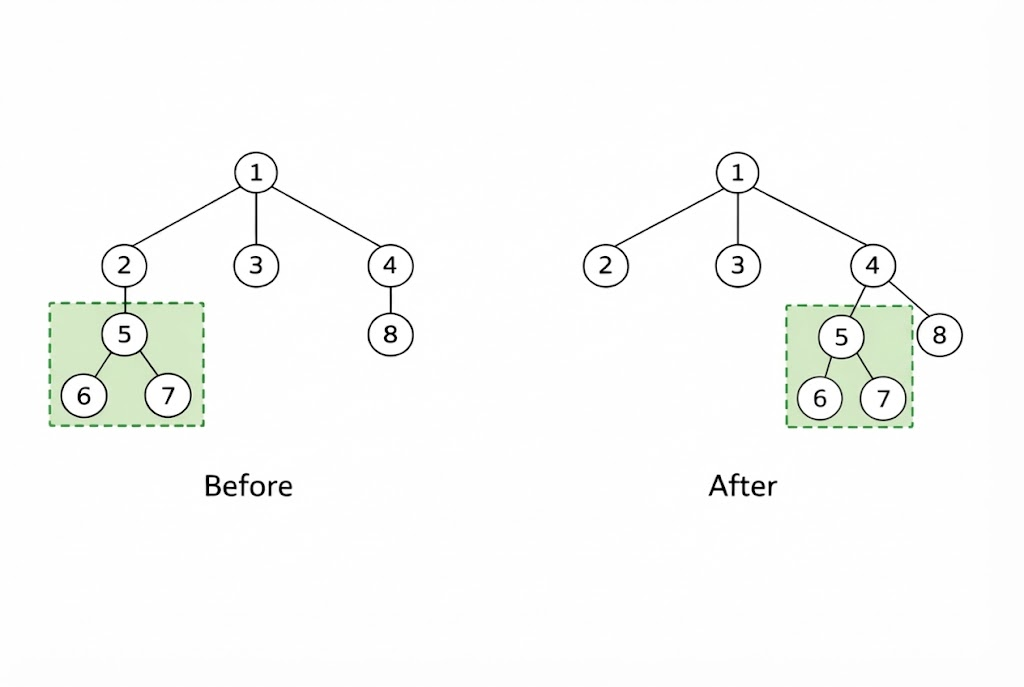
∗Formally, remove the edge from u to p, where p is the unique node satisfying d(u,p)=1 and d(u,r)=d(p,r)+1
对于一棵以节点 r 为根的树 T,其中每个节点 u 关联一个值 au,该树的代价定义为:
u∈T∑(au⋅d(r,u))
此处,求和遍历树 T 中的所有节点 u,而 d(r,u) 表示树上从节点 r 到节点 u 的最短路径所包含的边数。
给定一棵含 n 个节点的树,其根节点为节点 1。每个节点 i 被赋予一个值 ai。对每个 r(从 1 到 n),请独立求解如下问题:
考虑以节点 1 为参考时节点 r 的子树。形式化地,节点 r 的子树是指所有满足“从节点 1 到节点 u 的最短路径经过 r”的节点 u 所构成的树。
在对该子树至多执行一次如下操作的前提下,求该子树所能达到的最大代价:
- 任选一个节点 u(要求 u=r)。删除节点 u 与其父节点之间的边∗;然后,将节点 u 与任意一个仍能从 r 到达的节点 v 连接一条新边。可以证明,执行该操作后图仍为一棵树。
例如,下图展示了一个操作示例,其中 r=1、u=5、v=4:
∗形式化地,删除节点 u 与节点 p 之间的边,其中 p 是唯一满足 d(u,p)=1 且 d(u,r)=d(p,r)+1 的节点。
输入格式
Each test contains multiple test cases. The first line contains the number of test cases t (1≤t≤104). The description of the test cases follows.
The first line of each testcase contains a single integer n (1≤n≤2⋅105) — the count of nodes in the tree.
The second line of each testcase contains n integers a1,a2,…,an (1≤ai≤2⋅105).
Then n−1 lines follow, the i-th line containing two integers u and v (1≤u,v≤n) — the two nodes that the i-th edge connects.
It is guaranteed that the given edges form a tree.
It is guaranteed that the sum of n does not exceed 2⋅105 over all test cases.
每个测试包含多个测试用例。第一行包含测试用例的数量 t(1≤t≤104)。随后是各测试用例的描述。
每个测试用例的第一行包含一个整数 n(1≤n≤2⋅105)—— 树中节点的数量。
每个测试用例的第二行包含 n 个整数 a1,a2,…,an(1≤ai≤2⋅105)。
接下来是 n−1 行,其中第 i 行包含两个整数 u 和 v(1≤u,v≤n)—— 表示第 i 条边所连接的两个节点。
保证给定的边构成一棵树。
保证所有测试用例中 n 的总和不超过 2⋅105。
输出格式
For each test case, print n numbers – the answers for r=1,2,…,n.
对于每个测试用例,输出 n 个数字——即 r=1,2,…,n 对应的答案。
输入输出样例
输入#1
3
5
1 3 2 1 2
1 2
2 3
3 4
3 5
7
1 2 3 1 3 2 1
1 2
2 3
3 4
4 5
4 6
3 7
5
5 4 3 2 1
1 2
2 3
3 4
4 5
输出#1
18 10 5 0 0
40 28 18 8 0 0 0
20 10 4 1 0
说明/提示
In the first test case, for r=1, it is optimal to choose u=5 and v=4. The cost of the tree is then 1⋅0+3⋅1+2⋅2+1⋅3+2⋅4=18. It can be shown that a larger cost cannot be obtained over all legal operations.
For r=4 for example, there is only 1 node in the subtree, so there is no operation possible. The only possible cost of the subtree is 0.
在第一个测试用例中,当 r=1 时,选择 u=5 和 v=4 是最优的。此时树的代价为 1⋅0+3⋅1+2⋅2+1⋅3+2⋅4=18。可以证明,在所有合法操作下,无法得到更大的代价。
例如,当 r=4 时,子树中仅包含 1 个节点,因此无法执行任何操作。该子树的唯一可能代价为 0。
输入解题思路,AI测评打分。不知道怎么写?