

CF2190D.Prufer Vertex
省选/NOI-
通过率:0%
时间限制:2.00s
内存限制:256MB


AC君温馨提醒
该题目为【codeforces】题库的题目,您提交的代码将被提交至codeforces进行远程评测,并由ACGO抓取测评结果后进行展示。由于远程测评的测评机由其他平台提供,我们无法保证该服务的稳定性,若提交后无反应,请等待一段时间后再进行重试。
题目描述
For a tree T with n≥2 vertices, consider the standard process for generating its Prufer sequence. We repeatedly perform the following steps until only two vertices remain:
- Select the leaf with the smallest label;
- Remove it from the tree.
It is known that vertex n is always one of the two remaining vertices. Let v be the other remaining vertex. We define the Prufer vertex of T as P(T)=v.
You are given a forest with n vertices and m edges. Let k be the number of connected components in this forest, and let their sizes be s1,s2,…,sk. It is known that there are exactly nk−2i=1∏ksi ways to add edges to the forest so that it becomes a single tree.
For each v (1≤v<n), calculate how many of these ways result in a tree T satisfying P(T)=v.
Since the answers can be large, print them modulo 998244353.
对于一棵包含 n≥2 个顶点的树 T,考虑其 Prüfer 序列 的标准生成过程:我们不断重复以下步骤,直到树中仅剩两个顶点:
- 选取标号最小的叶子顶点;
- 将其从树中删除。
已知顶点 n 总是最后剩余的两个顶点之一。设另一个剩余顶点为 v。我们定义树 T 的 Prüfer 顶点为 P(T)=v。
给定一个包含 n 个顶点和 m 条边的森林。设该森林包含 k 个连通分量,各连通分量的大小依次为 s1,s2,…,sk。已知恰好有 nk−2i=1∏ksi 种方式向该森林添加边,使其成为一棵单一的树。
对每个 v(1≤v<n),计算有多少种这样的加边方式能产生一棵满足 P(T)=v 的树 T。
由于答案可能很大,请对 998244353 取模后输出。
输入格式
Each test contains multiple test cases. The first line contains the number of test cases t (1≤t≤104). The description of the test cases follows.
The first line of each test case contains two integers n and m (2≤n≤2⋅105, 0≤m≤n−1) — the number of vertices and edges in the forest, respectively.
The next m lines of each test case contain two integers u and v (1≤u,v≤n,u=v), describing an edge between vertices u and v. It is guaranteed that these edges form a forest (that is, the graph is acyclic).
It is guaranteed that the sum of n over all test cases does not exceed 2⋅105.
每个测试包含多个测试用例。第一行包含测试用例的数量 t(1≤t≤104)。随后是各测试用例的描述。
每个测试用例的第一行包含两个整数 n 和 m(2≤n≤2⋅105,0≤m≤n−1),分别表示森林中的顶点数和边数。
每个测试用例接下来的 m 行,每行包含两个整数 u 和 v(1≤u,v≤n,u=v),表示顶点 u 与顶点 v 之间存在一条边。保证这些边构成一个森林(即该图无环)。
保证所有测试用例的 n 之和不超过 2⋅105。
输出格式
For each test case, print n−1 integers on a single line. The i-th integer should be the number of ways to add edges to the forest so that it becomes a tree T satisfying P(T)=i, modulo 998244353.
对于每个测试用例,在一行中输出 n−1 个整数。其中第 i 个整数表示:向该森林中添加边使其成为一棵树 T,且满足 P(T)=i 的方案数,对 998244353 取模的结果。
输入输出样例
输入#1
3
3 0
5 4
4 2
3 4
1 2
4 5
6 3
1 6
6 4
2 1
输出#1
1 2
0 0 0 1
12 0 1 6 5
说明/提示
In the first example, there are no edges in the forest, and there are 3 ways to complete it to a tree. One of them is to add edges (1,2) and (1,3). There are 2 leaves: vertex 2 and 3. Since 2 has a smaller label, it gets deleted from the tree, and only two vertices remain: 1 and 3. Therefore, the Prufer vertex of this tree is 1.
In the third example, the forest is shown below:
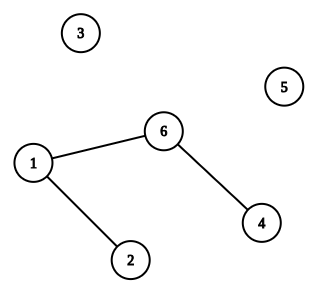
Suppose we add edges (3,5) and (3,1) to complete it to a tree T. It is going to look like this:
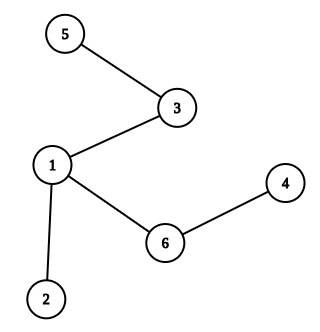
It can be shown that P(T)=1.
在第一个例子中,森林中没有边,将其补全为一棵树共有 3 种方式。其中一种是添加边 (1,2) 和 (1,3)。此时树中有 2 个叶子节点:顶点 2 和 3。由于 2 的标号更小,它将从树中被删除,剩余两个顶点为 1 和 3。因此,该树的 Prüfer 编码顶点为 1。
在第三个例子中,森林如下图所示:
假设我们添加边 (3,5) 和 (3,1) 将其补全为一棵树 T,则该树形如:
可以证明,P(T)=1。
输入解题思路,AI测评打分。不知道怎么写?