

CF232C.Doe Graphs
省选/NOI-
通过率:0%
时间限制:3.00s
内存限制:256MB


AC君温馨提醒
该题目为【codeforces】题库的题目,您提交的代码将被提交至codeforces进行远程评测,并由ACGO抓取测评结果后进行展示。由于远程测评的测评机由其他平台提供,我们无法保证该服务的稳定性,若提交后无反应,请等待一段时间后再进行重试。
题目描述
John Doe decided that some mathematical object must be named after him. So he invented the Doe graphs. The Doe graphs are a family of undirected graphs, each of them is characterized by a single non-negative number — its order.
We'll denote a graph of order k as D(k), and we'll denote the number of vertices in the graph D(k) as |D(k)|. Then let's define the Doe graphs as follows:
- D(0) consists of a single vertex, that has number 1.
- D(1) consists of two vertices with numbers 1 and 2, connected by an edge.
- D(n) for n ≥ 2 is obtained from graphs D(n - 1) and D(n - 2). D(n - 1) and D(n - 2) are joined in one graph, at that numbers of all vertices of graph D(n - 2) increase by |D(n - 1)| (for example, vertex number 1 of graph D(n - 2) becomes vertex number 1 + |D(n - 1)|). After that two edges are added to the graph: the first one goes between vertices with numbers |D(n - 1)| and |D(n - 1)| + 1, the second one goes between vertices with numbers |D(n - 1)| + 1 and 1. Note that the definition of graph D(n) implies, that D(n) is a connected graph, its vertices are numbered from 1 to |D(n)|.
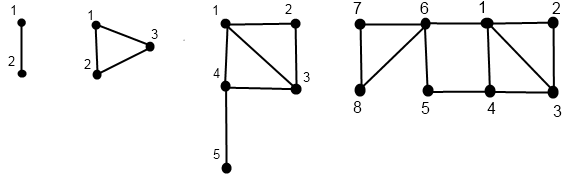 The picture shows the Doe graphs of order 1, 2, 3 and 4, from left to right.
John thinks that Doe graphs are that great because for them exists a polynomial algorithm for the search of Hamiltonian path. However, your task is to answer queries of finding the shortest-length path between the vertices a__i and b__i in the graph D(n).
A path between a pair of vertices u and v in the graph is a sequence of vertices _x_1, _x_2, ..., x__k (k > 1) such, that _x_1 = u, x__k = v, and for any i (i < k) vertices x__i and x__i + 1 are connected by a graph edge. The length of path _x_1, _x_2, ..., x__k is number (k - 1).
约翰·多伊(John Doe)认为某种数学对象必须以他的名字命名,于是他发明了“多伊图”(Doe graphs)。多伊图是一族无向图,其中每个图均由一个唯一的非负整数——其“阶”(order)——刻画。
我们将阶为 k 的图记作 D(k),并将图 D(k) 中的顶点数记作 ∣D(k)∣。于是,多伊图定义如下:
- D(0) 仅包含一个编号为 1 的顶点;
- D(1) 包含两个编号分别为 1 和 2 的顶点,并由一条边相连;
- 对于 n≥2,图 D(n) 由图 D(n−1) 和 D(n−2) 构造而成:将 D(n−1) 与 D(n−2) 合并为一个图,其中 D(n−2) 中所有顶点的编号均增加 ∣D(n−1)∣(例如,图 D(n−2) 中编号为 1 的顶点变为编号为 1+∣D(n−1)∣ 的顶点)。随后,在该图中添加两条边:第一条边连接编号为 ∣D(n−1)∣ 和 ∣D(n−1)∣+1 的顶点;第二条边连接编号为 ∣D(n−1)∣+1 和 1 的顶点。注意,根据图 D(n) 的定义,D(n) 是连通图,且其顶点编号从 1 到 ∣D(n)∣。
图中从左至右依次展示了阶为 1、2、3 和 4 的多伊图。
约翰认为多伊图极为出色,是因为在其上存在一种多项式时间算法可用于寻找哈密顿路径。然而,你的任务是回答若干查询:对给定的图 D(n),求顶点 ai 与 bi 之间的最短路径长度。
图中一对顶点 u 与 v 之间的路径是指一个顶点序列 x1,x2,…,xk(其中 k>1),满足 x1=u,xk=v,且对任意 i<k,顶点 xi 与 xi+1 由图中的一条边相连。路径 x1,x2,…,xk 的长度定义为 k−1。
输入格式
The first line contains two integers t and n (1 ≤ t ≤ 105; 1 ≤ n ≤ 103) — the number of queries and the order of the given graph. The i-th of the next t lines contains two integers a__i and b__i (1 ≤ a__i, b__i ≤ 1016, a__i ≠ b__i) — numbers of two vertices in the i-th query. It is guaranteed that a__i, b__i ≤ |D(n)|.
Please, do not use the %lld specifier to read or write 64-bit integers in С++. It is preferred to use cin, cout streams or the %I64d specifier.
第一行包含两个整数 t 和 n(1≤t≤105;1≤n≤103)—— 分别表示查询次数和给定图的阶数。接下来的 t 行中,第 i 行包含两个整数 ai 和 bi(1≤ai,bi≤1016,且 ai=bi)—— 表示第 i 次查询中的两个顶点编号。保证 ai,bi≤∣D(n)∣。
请注意,在 C++ 中读写 64 位整数时,请勿使用 %lld 说明符。推荐使用 cin、cout 流,或 %I64d 说明符。
输出格式
For each query print a single integer on a single line — the length of the shortest path between vertices a__i and b__i. Print the answers to the queries in the order, in which the queries are given in the input.
对于每个查询,在单独的一行上输出一个整数——顶点 ai 与 bi 之间最短路径的长度。请按照输入中查询给出的顺序输出各查询的答案。
输入输出样例
输入#1
10 5
1 2
1 3
1 4
1 5
2 3
2 4
2 5
3 4
3 5
4 5
输出#1
1
1
1
2
1
2
3
1
2
1
输入解题思路,AI测评打分。不知道怎么写?